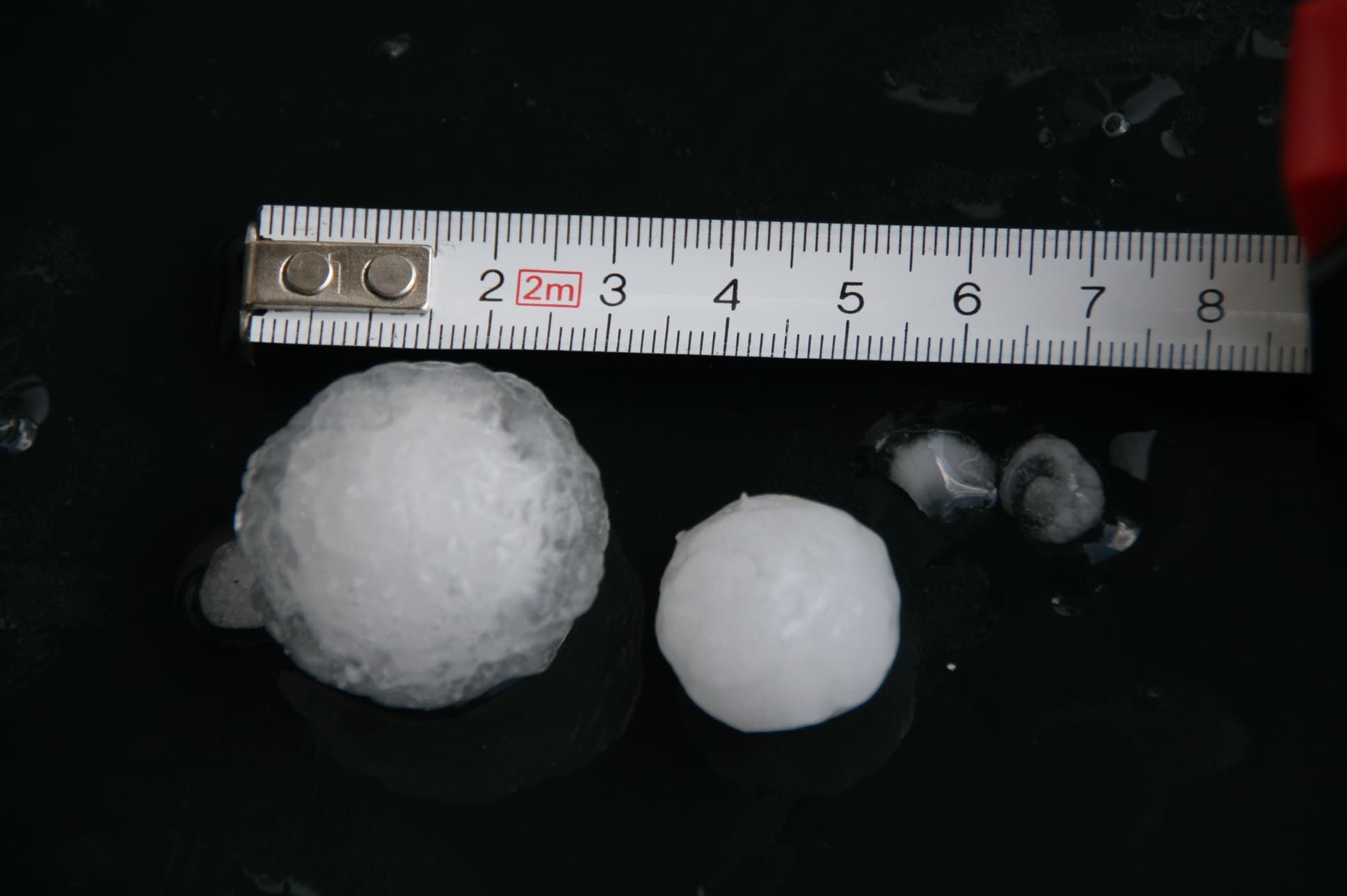
Class 4 Impact-Resistant Shingles in Chippewa Falls, WI
What a UL 2218 Class 4 rating actually tests, how Chippewa Valley hail measures up against it, and how to tell whether impact-resistant shingles will pay back on your roof.
Price a Class 4 Shingle Roof
Tell us what's going on with your roof and we'll call you back.
- Free roof estimates
- Class 4 upgrade priced as its own line
- Product and rating named in writing
Class 4 Shingles and the UL 2218 Impact Test: Four Classes, One Steel Ball
UL 2218 is the impact test written on most shingle wrappers. A steel ball is dropped through a tube onto a mounted roof sample. The ball gets bigger and the drop longer with each class. Class 4 is the top of the ladder.
- Class 1 1¼ in steel ball, dropped 12 ft Roughly a half-dollar coin.
- Class 2 1½ in steel ball, dropped 14–15 ft Ping-pong ball size. Summaries of the standard list 14 or 15 feet.
- Class 3 1¾ in steel ball, dropped 17 ft Golf-ball size.
- Class 4 2 in steel ball, dropped 20 ft Hen-egg size. The top class.
Balls drawn to scale with each other. Ball sizes from the Insurance Institute for Business and Home Safety (IBHS); drop heights from manufacturer summaries of the standard, which is sold by UL and not public.
Two steel-ball hits on the same spot
Each target point on the sample takes two strikes from the same ball in the same place, so a shingle that only just survives the first hit has to survive a second.
No crack through the shingle's back
The sample is turned over and checked for any crack or opening. Dents and scuffs on the top surface do not count as a failure. Granule loss is not scored at all.
Not a lifespan or a hail forecast
The samples are new shingles, tested in a lab. A steel ball is not a hailstone. The rating is a fair yardstick for comparing products, not a promise about any one storm.
A second test, FM 4473, fires ice balls in the same four sizes at a matching energy. It was written for rigid roofing such as tile and slate, though some shingle makers list it next to UL 2218. If a discount is on the table, ask your insurer which of the two it accepts.
Are Class 4 Shingles Worth It in Chippewa Falls? A Payback Scorecard
There is no single answer for the whole county. Tick what is true for your house. The more boxes, the stronger the case for paying extra.
Boxes ticked: count updates as you tick of 7
- 0 to 2
- A standard architectural shingle is a sound choice. Spend on ice barrier and ventilation first.
- 3 to 4
- Have both shingles priced on the same estimate and decide on the actual difference.
- 5 to 7
- The upgrade is likely to earn its keep on this house.
A rule of thumb from how roofs here age and fail, not a formula. Seven questions cannot see your roof.
When we would not push Class 4 shingles
- You plan to sell within a few years. The upgrade pays back over storm seasons, and you may not be there to collect.
- The budget is tight. If the choice is Class 4 shingles or a proper run of ice barrier and balanced attic ventilation, take the ice barrier and ventilation. In this climate more roofs are shortened by ice and attic heat than by hail.
- It is a detached garage or shed. Hail damage on a small outbuilding roof is usually cheap to put right with standard shingles.
- Hail is the only reason you are re-roofing and you want the fewest possible leaks from it. Steel is the better answer for that, with the caveats in the table below.
Turning down an upgrade we would make money on is part of giving you a straight estimate.
Hail Resistant Shingles vs. Chippewa Valley Hail: Local Stones Against the 2-Inch Test Ball
These are real reports from the last few seasons, drawn to the same scale as the Class 4 test ball.
- 1½ in Eau Claire County June 19, 2026 · NWS Twin Cities
- 1¾ in Chippewa Falls (app report) May 15, 2025 · SPC, preliminary
- 2 in Class 4 test ball UL 2218 · steel, dropped 20 ft
- 2 in 3 mi SW of Chippewa Falls (app report) May 15, 2025 · SPC, preliminary
- 3 in 3 mi NE of Bloomer July 28, 2023 · SPC storm reports
- 4 in Altoona May 15, 2025 · NWS Twin Cities
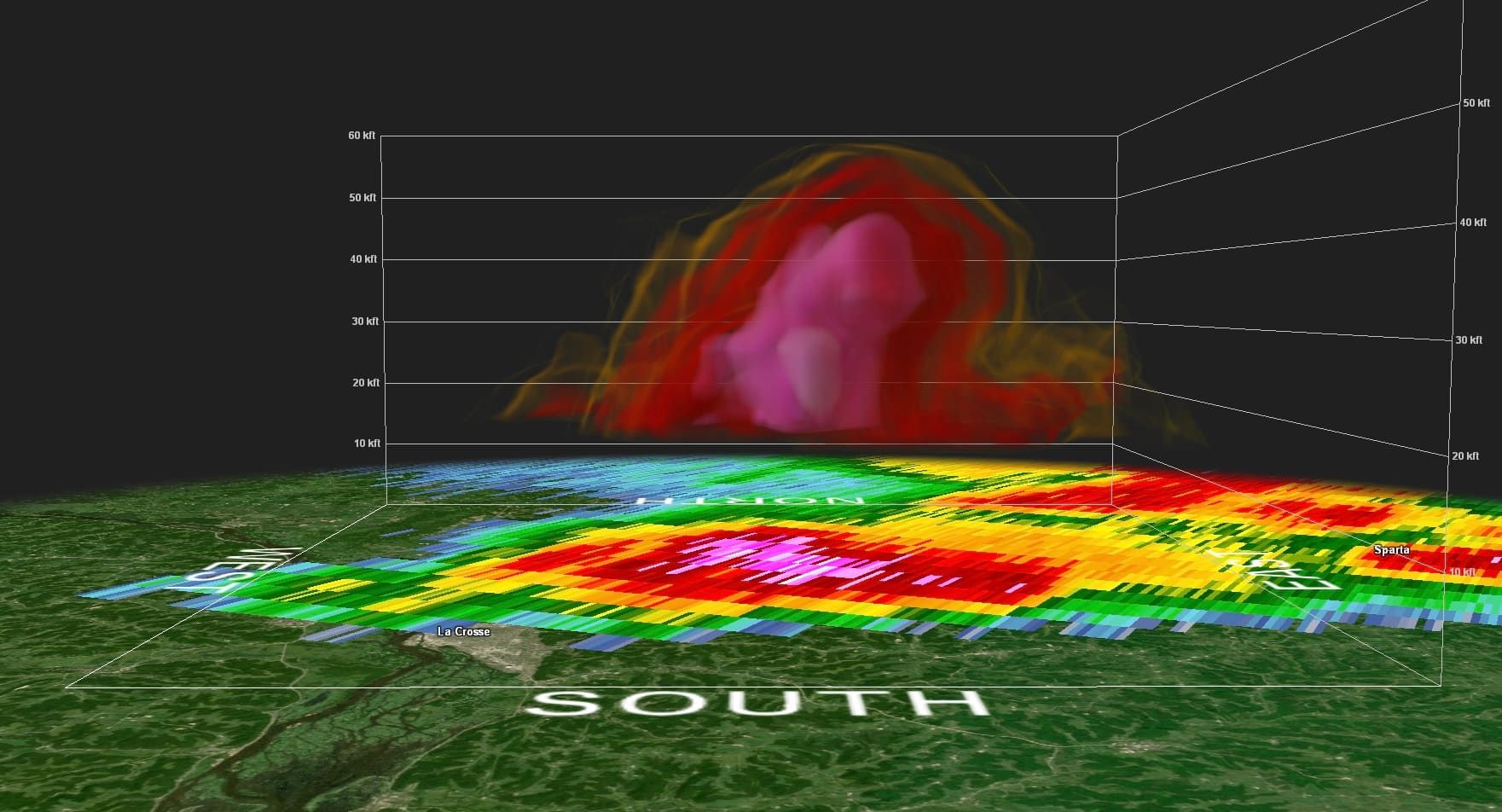
What the reports say about a Class 4 roof here
On July 28, 2023, the Storm Prediction Center logged 1¾-inch and then 3-inch "spiky" hail three miles northeast of Bloomer. The same evening, the storm shown in this National Weather Service radar scan dropped hail up to 4 inches near West Salem in La Crosse County. On May 15, 2025, reports reached 4 inches at Altoona, and preliminary app reports put 1¾- to 2-inch stones around Chippewa Falls.
Read honestly, that cuts both ways. Plenty of storms here bring stones no bigger than the test ball: the Eau Claire County hail of June 2026 topped out at 1½ inches. That is where a Class 4 shingle earns its money. The 3- and 4-inch stones of 2023 and 2025 are well past it, and no shingle is rated for them.
Small hail matters too. A 2025 IBHS study found that repeated hail under an inch wears granules off and leaves shingles that have weathered a couple of years far more open to the next large storm. Impact-rated shingles in that study did only slightly better than standard ones.
Radar image: National Weather Service, La Crosse. Hail reports: NWS and SPC; app reports are preliminary.
Standard Architectural vs. Class 4 vs. Steel: What Holds Up to Hail in Chippewa County
The three roofs people weigh after a storm, compared on the points that matter for hail. No prices here: those depend on your roof, and we write them on your estimate.
| Compared on | Standard architectural | Class 4 shingle | Steel panels |
|---|---|---|---|
| Impact rating | Usually none, or a lower class | UL 2218 Class 4 on the product sheet | Many panels are listed at UL 2218 Class 4 |
| What hail does | Bruises, knocks off granules, can crack the mat | Fewer cracked mats at the same hail size; granules still lost | Rarely punctured; dented by large hail |
| Cosmetic damage wording | Depends on the policy | Ask whether a discount comes with a cosmetic damage endorsement | Dents are what these clauses are written for; check before you buy |
| Up-front price | Lowest of the three | Higher, mostly in the material | Highest of the three |
| Cold-weather install | Stiffens in the cold; careful handling and hand-sealing | Polymer lines are sold as more pliable in the cold | Not limited by sealant strips |
| Looks from the street | Laminated shadow lines | Same as standard in most lines | Ribs or seams, or stamped to imitate shingles |
| Repair after a storm | Individual shingles replaced | Individual shingles replaced, from the same line | Whole panels replaced; matching an old color is harder |
When steel is the better hail answer
Steel is the roof hail is least likely to put a hole in. One panel maker's technical bulletin lists dozens of its panels at UL 2218 Class 4 and says plainly that they can still be dented. Another maker's literature calls a dent aesthetic, not functional damage its warranty covers. A dented steel roof keeps shedding water, but if your policy carries a cosmetic damage clause, those dents may never be paid for.
So steel wins when you want the fewest leaks from hail over the longest time, the roof is a simple shape, and you can live with dents. A Class 4 shingle wins on price, on cut-up roofs, and on hiding small hits. The metal side of that decision is covered under metal roofing on our site.
Impact-Resistant Shingles Tested Further: What IBHS Ratings Found
Every shingle IBHS rates is sold as impact-resistant. Its testing shows they do not all perform the same.
- ExcellentNone of the 24 products rated in November 2025 reached it
- GoodWith Excellent, the only ratings accepted on FORTIFIED roofs installed from November 1, 2025
- MarginalCarries an impact label, tests weaker
- PoorCarries an impact label, tests weakest
Since 2019 the Insurance Institute for Business and Home Safety, a research group funded by insurers, has fired laboratory-made hailstones at impact-resistant shingles and rated them on a four-step scale. In its first round, every product tested carried an impact-resistant label, and results still ranged from Excellent to Poor. In the fourth round, released in November 2025, a record 24 products were rated and none reached Excellent.
Construction is part of the spread. Impact-rated shingles generally get there in one of two ways: a reinforced mat, or asphalt modified with a rubber-like polymer, usually SBS, so the shingle gives under a blow and recovers. In IBHS testing published in 2014, the polymer-modified shingles did about 20 to 50 percent better than the traditional impact-rated ones.
Lines sold as UL 2218 Class 4 include CertainTeed Landmark ClimateFlex, IKO Nordic, Malarkey Vista, Owens Corning Duration FLEX and TAMKO StormFighter FLEX, among others. We list them as examples from each maker's own product literature, not as a ranking. Before you choose, look up the line's current IBHS rating, and ask us which one is on your estimate.
Class 4 Shingle Discounts From Wisconsin Insurers, and Cosmetic Damage Endorsements
The usual sales pitch is that the insurance discount pays for the shingle. Sometimes it does. In Wisconsin it is up to each insurer: we found no state law or Office of the Commissioner of Insurance rule that requires one. That differs from Minnesota, where state law requires a premium discount for roofs built to the FORTIFIED standard, and Texas, whose insurance department set mandatory credits for qualifying impact-resistant roofs in 1998.
Ask your agent four things before you pay extra on the strength of a discount:
- Is there a discount for this roof, and how much a year? Get a dollar figure for your own policy, not a general promise.
- Does it come with a cosmetic damage endorsement? One such form filed with Wisconsin's insurance regulator in 2023 says the insurer will not pay for "cosmetic damage" to roof surfacing caused by windstorm or hail, meaning marring, scratching or denting that does not stop the roof keeping the weather out. On a Class 4 roof that can mean a storm leaves visible marks and no payment.
- What paperwork do they want? Usually the product name and rating, and sometimes a form we fill in. The list further down covers it.
- How is an older roof paid for? If the policy moves to actual cash value as the roof ages, a discount today is worth less than it looks.
We are roofers, not agents, and we cannot tell you what your policy says. We can put the product and its rating in writing so your agent can answer precisely.
Upgrading to Class 4 when the insurer pays for the roof
After a covered hail loss, the insurer generally pays to put back what you had, a like-for-like roof. If you want Class 4 shingles instead, you pay the difference. Because the tear-off, underlayment, flashing and labor are the same on either roof, that difference is mostly the shingle itself. We show it as its own line so the insurer's amount and yours never blur together.
How the Class 4 Upgrade Shows Up on a Written Estimate
We will not quote a percentage for the upgrade here. Shingle prices change by maker, line and season, and we have not found a published installed figure we trust. What we can show is where the difference sits.
Almost everything on a re-roof is the same with either shingle: tear-off, decking repairs, ice barrier, underlayment, flashing, vents and clean-up. The lines that change are the shingle bundles and the matching hip and ridge caps. So the estimate prices the roof once, then adds one line for the upgrade.
That makes the decision simple to weigh against the scorecard above, your deductible and any discount your agent confirms.
- Tear-off to the deck, haul-awaysame either way
- Decking repairs, per sheetsame either way
- Ice barrier at eaves and valleys, underlaymentsame either way
- Flashing, drip edge, vents and pipe bootssame either way
- Architectural shingles, starter, hip and ridgebase price
- Upgrade: Class 4 line of the same color, with matching capsthe difference
Class 4 Shingles Below Freezing: Polymer Asphalt That Bends Instead of Cracking
Asphalt gets stiff in the cold. The Asphalt Roofing Manufacturers Association says shingles become less flexible as the temperature drops and may crack when handled, recommends storing bundles somewhere warm before they go up, and calls for hand-sealing in very cold weather. The sealant strips that glue each course down are activated by the sun's warmth on the roof, so a roof laid late in the year may not seal fully until spring.
This is one place polymer-modified Class 4 lines help. Makers sell them as more pliable in the cold, and some advertise installation at lower temperatures than standard shingles. In Eau Claire, where the normal January low is under 6°F and the March normals are 41°F by day and 21°F by night, that widens the season a little at both ends. It does not make a January install a good idea, and we still hand-seal and do not promise a seal before spring.
One older finding is worth knowing. A 1969 National Bureau of Standards study of hail on roofing found shingles resisted hail better when warm, and noted that storm clouds cool a roof before the hail arrives. Ratings are earned on new shingles in a lab. A cool spring storm on an aging roof is a harder test.
Papers to Keep for Your Insurer Once a Class 4 Roof Is On
A discount, or a fair hearing on a future claim, depends on proving what is on the roof. Put these in one folder or one email thread.
- The final invoiceNaming the manufacturer, product line and color, the install date and the slopes covered.
- The product sheetThe maker's current page or data sheet for that line, showing its UL 2218 Class 4 listing.
- Wrapper photosA photo of a bundle wrapper with the product name and lot code, taken on the job.
- Finished-roof photosEach slope after clean-up, dated. They show the roof's condition before any later storm.
- Warranty registrationThe manufacturer's confirmation, if the line requires or offers registration.
- Permit recordIn the City of Chippewa Falls a full re-roof needs a building permit unless the project is under $2,000. Outside the city, the town, village or county office.
- Your insurer's roof formIf your company has its own certificate for impact-rated roofs, we fill in our part.
- The agent's discount in writingThe amount and the policy it applies to, with any endorsement that came with it.
Still choosing among shingle lines, colors and warranties? Start with our page on asphalt shingle roofing in Chippewa Falls. For repairs, steel and flat roofs and everything else we do, start with our roofing company in Chippewa Falls home page. Phone and text hours: Open 8am–6pm.
Class 4 Shingle FAQ: Hail-Proof, Discounts, Aging and FM 4473
Are Class 4 shingles hail proof?
No. Class 4 means a sample survived two strikes from a 2-inch steel ball in a lab without an opening showing on its back. Real hail varies in size, shape and speed, comes with wind, and lands on shingles that have aged for years. A Class 4 roof comes through ordinary storms with fewer damaged shingles than a standard one. Stones larger than the test ball, like the 3- and 4-inch hail reported near Bloomer in 2023 and Altoona in 2025, can still damage it.
Will Class 4 shingles lower my homeowners insurance?
Possibly. Some insurers give a premium discount for an impact-rated roof and some do not, and the size of it varies. Get the figure for your own policy in writing, and ask whether the discount comes with a cosmetic damage endorsement or another change to how hail on the roof is handled, before you pay for the upgrade on that basis.
Does Wisconsin require insurers to discount a Class 4 roof?
Not that we could find. We found no Wisconsin statute or Office of the Commissioner of Insurance rule that requires one, so any discount here is the insurer's own choice. Minnesota and Texas are examples of states that do require credits for qualifying roofs, under their own rules. Your agent is the one who can tell you what your company offers.
Do Class 4 shingles look different from regular architectural shingles?
Not from the street. Most are laminated architectural shingles in the same profiles and colors as the standard lines from the same maker. The difference is inside the shingle, usually a polymer-modified asphalt that flexes under a blow where ordinary asphalt cracks.
Do Class 4 shingles last longer than standard shingles?
The rating does not say so. UL 2218 measures impact on a new shingle, not lifespan, and research by the Insurance Institute for Business and Home Safety found that even short-term natural weathering can measurably reduce hail performance. Attic ventilation, ice protection and the quality of the install decide most of a roof's life here. Compare the manufacturer's warranty documents rather than assuming.
Is an FM 4473 rating the same as UL 2218 Class 4?
They are different tests with the same four ball sizes. UL 2218 drops steel balls; FM 4473 fires ice balls at a matching energy and was written for rigid roofing such as tile and slate. Some shingle makers list both. UL 2218 is the one printed on most shingle wrappers, but if a discount depends on it, ask your insurer which test it accepts.
Does a Class 4 roof still need checking after a hailstorm?
Yes. Granules still come off, vents and flashing still dent, and very large stones can still crack the shingle. A look after any storm with hail an inch or larger costs nothing and gives you dated photos while the policy deadlines are still open.
Get Standard and Class 4 Shingles on One Written Estimate
We measure the roof and write both shingles up as separate lines, so the upgrade is a number you can weigh against your own reasons for it.