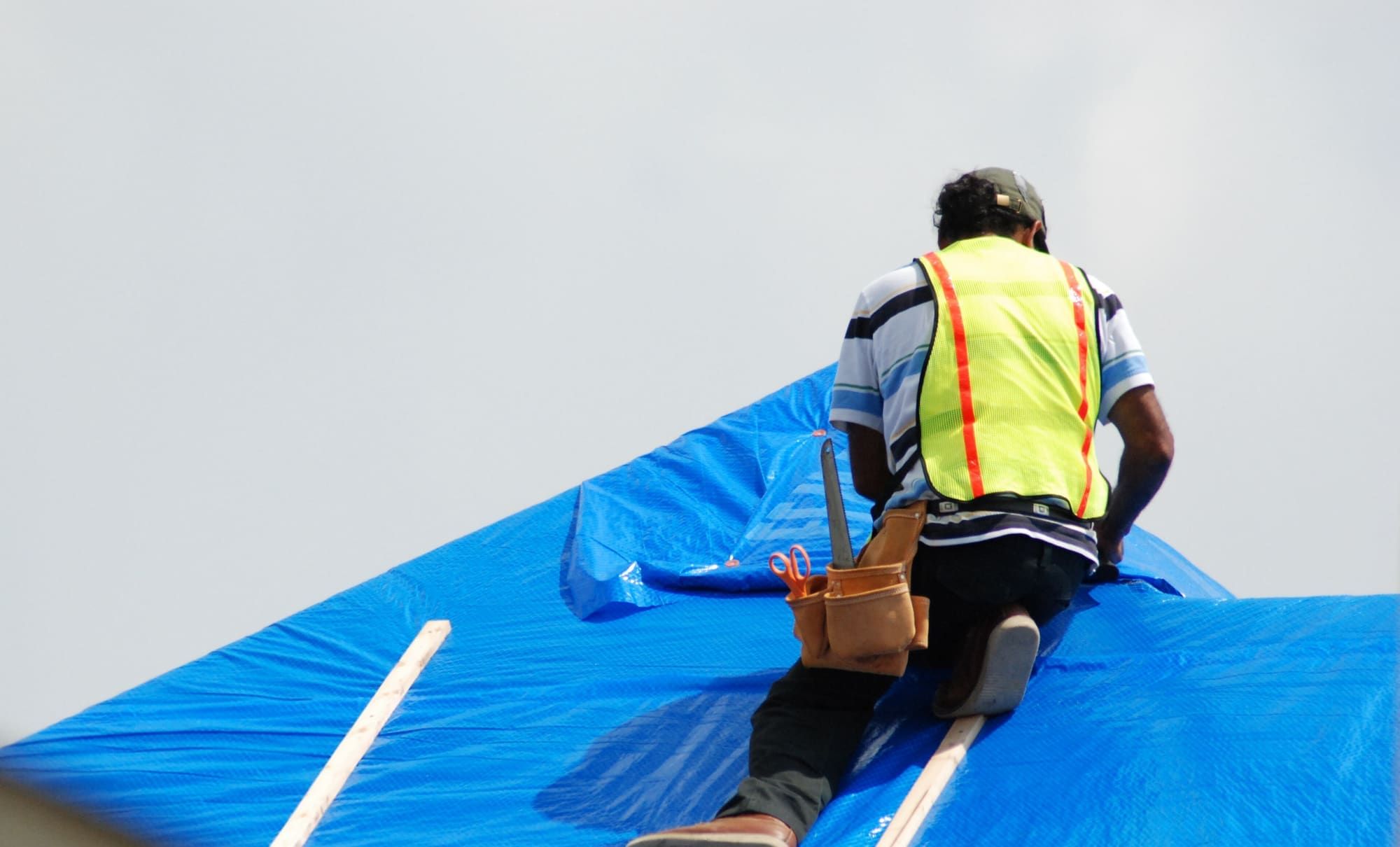
Emergency Roof Tarping in Chippewa Falls, WI
When the roof is open and rain or snow is on the way, the first job is to get it covered so the house stays dry until it can be repaired properly. Here is how a tarp goes on so it stays on through Chippewa Valley wind and snow, how long it lasts, and what your insurer will want to see.
Need the Roof Covered?
Tell us what's going on with your roof and we'll call you back.
- Tarps anchored with boards, not bricks
- Before and after photos for your adjuster
- Open 8am–6pm
When a Roof Needs an Emergency Tarp, and When a Patch Does Better
A tarp is for a roof that has lost its ability to shed water and cannot be repaired properly before the next weather arrives. It buys time. It is not the only way to buy time, and on a small opening it is often the worse one, because every tarp puts fasteners into the roof around it.
| What you see | The usual first move |
|---|---|
| A slope stripped to the underlayment or bare wood after a thunderstorm | Full tarp, over the ridge |
| A limb through the deck, daylight in the attic | Plywood over the hole, then a tarp over the plywood |
| Three or four shingles missing on an otherwise sound roof | Replace them on the spot if we have a match; no tarp needed |
| A drip at a cracked pipe boot or one failed flashing | A temporary patch slipped under the shingles above it |
| A puncture or open seam on a flat porch or garage roof | A membrane patch; a tarp would only hold water |
| Water at an outside wall in a January thaw, ice at the eave | Usually not a tarp at all; see the winter section below |
We will tell you on the phone which of these it sounds like, and say so if a tarp would do more harm than good.
If water is coming in right now: switch off any light or fan it is running through at the breaker, catch it in buckets, and if a ceiling is bulging, keep everyone out from under it. Stay off the roof. Then call (715) 233-8665.
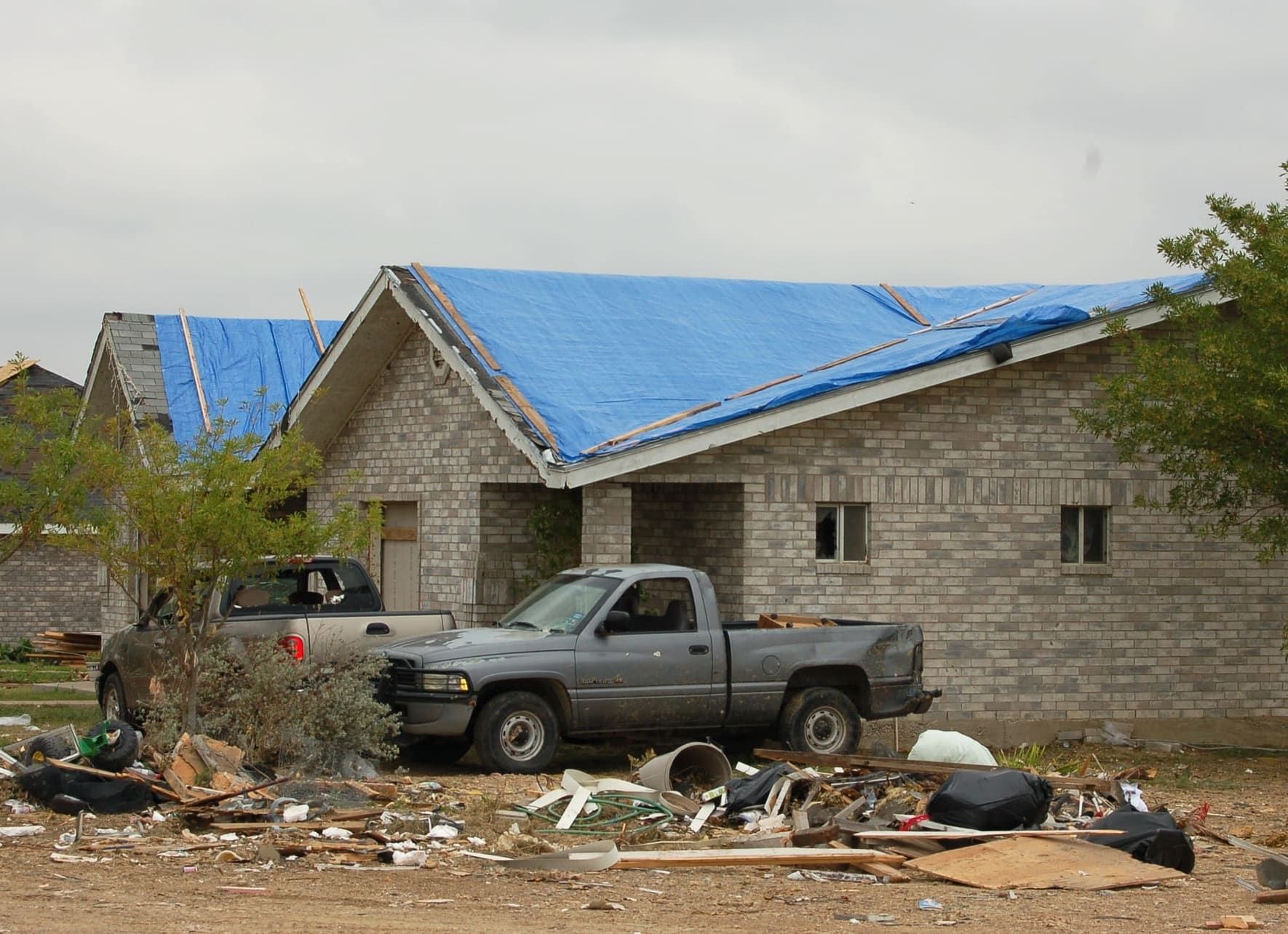
How an Emergency Roof Tarp Is Anchored So It Holds: Over the Ridge, Boards and Battens
Most tarps that fail were held with bricks, sandbags or a few nails through the grommets. Wind gets under one edge and the whole sheet is in the neighbor's yard by morning, often with the shingles it was flapping against. One that holds goes on like this:
- Photograph, then clear. The damage is photographed first. Then loose shingles, broken decking and branches come off so nothing punctures the sheet from below.
- Bridge any hole. Where the deck is broken through, plywood is screwed over the opening so the tarp does not sag into it and fill like a pool.
- Size it to run over the ridge. The tarp extends several feet past the damage on each side and, wherever the roof allows, over the ridge and down the other slope. Water running down the roof then meets no uphill edge to slip under.
- Wrap the edges around boards. Each edge is rolled around a length of lumber and the board is screwed through to the roof deck. The load spreads along the whole edge instead of tearing out at the grommets.
- Batten up the slope, never across it. On a large tarp, more boards run from the eave toward the ridge to stop the field from ballooning. A board laid across the slope dams water behind it.
- Seal the screw heads. Fasteners go where the roof will be repaired anyway wherever possible, and each one is sealed so the tarp does not add leaks of its own.
Why roof tarps blow off
- Weights instead of fasteners. Bricks and tires slide, and they gouge shingles when they do.
- A top edge below the ridge. Water runs under it in the first rain.
- Loose field, no battens. The sheet fills with wind like a sail and works the edge boards loose.
- Thin tarp, long stay. Sun makes light poly brittle within weeks, and it splits along every fold.
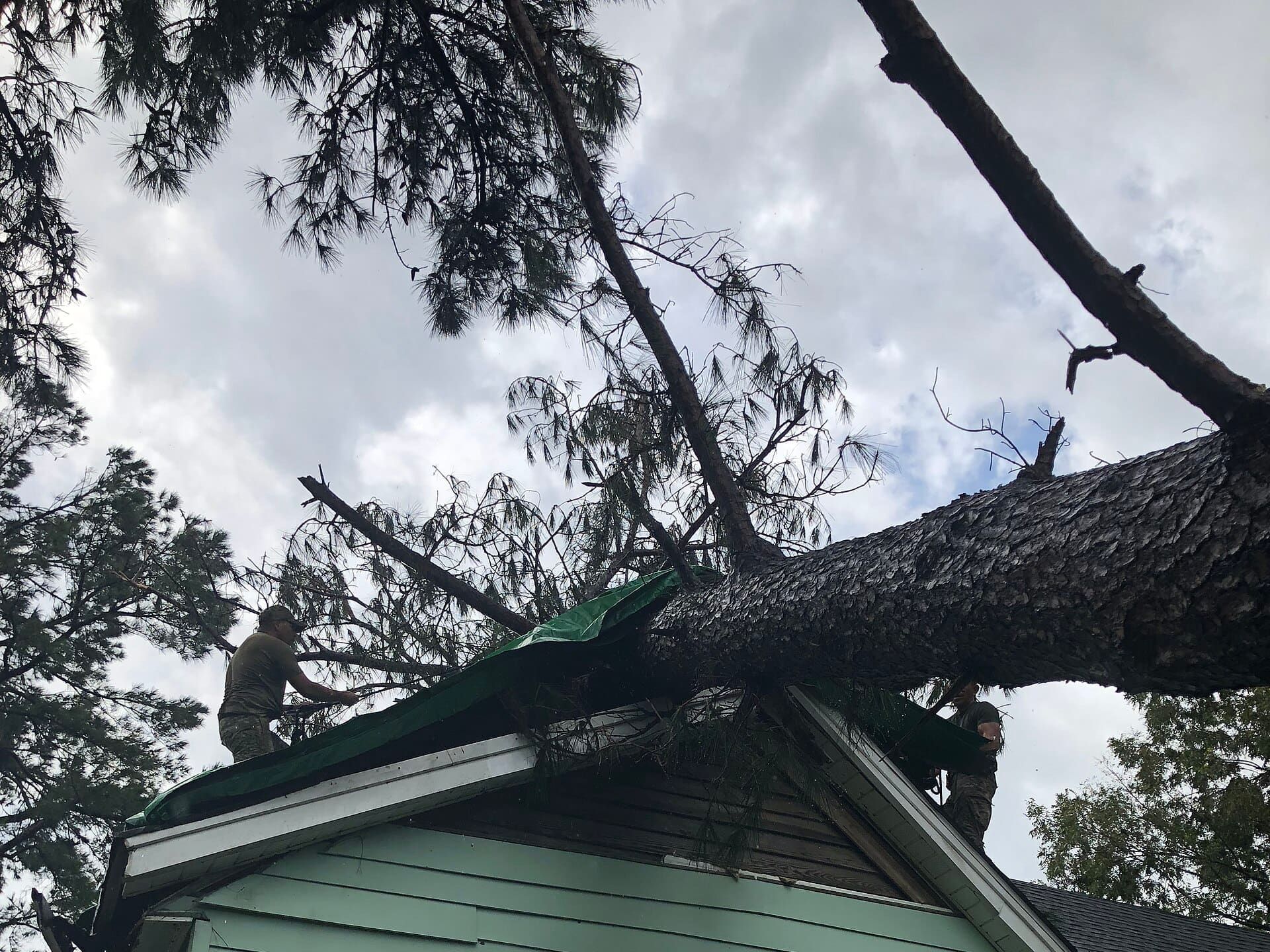
Tarping Storm Openings and Tree Limb Holes Around Chippewa Falls
Summer thunderstorms do most of the opening in the Chippewa Valley. The National Weather Service recorded significant straight-line wind damage in Chippewa County on May 15, 2025, and storms like that do two things to a roof: strip shingles off the windward slope in a band, and drop limbs.
Wind-stripped slopes
A band of missing shingles along a rake or ridge is the classic tarp job. The underlayment left behind sheds a light rain for a while, then tears. We cover the whole band, not just the bare wood, because the shingles on its edges have usually lost their seal and will be the next to go.
Limbs and trees through the deck
Wooded lots are where the holes come from: older streets near downtown and Irvine Park with big trees over the houses, homes along the Chippewa River, and lake homes around Lake Wissota with oaks and pines on every side. A limb that punches through leaves broken decking and sometimes a cracked rafter.
The tree has to come off first. A tree service removes anything heavy or still attached; if wires are involved, the utility comes before anyone. Then we plate the hole with plywood and tarp over it. If a rafter or truss is cracked, we tell you, and the permanent fix may need a carpenter as well as a roofer. What happens after that, from framing to new decking, is on our tree damage roof repair page.
Hail, skylights and plastic vents
Hail rarely calls for a tarp. It bruises shingles and dents metal, which matters for the claim, but it seldom opens the roof. The exceptions are broken skylights, cracked plastic vents and translucent panels on sheds, and those get a cover the same day.
Winter Tarping in the Chippewa Valley: Snow on the Sheet, Frozen Eaves, Steep Pitches
Normal snowfall at the nearby Eau Claire station is 55.4 inches a year, and March there averages highs around 41°F and lows around 21°F: weeks of melting by day and freezing at night. A tarp put on between November and April has to deal with all of it.
Snow on top of the tarp
Snow is cleared off the damaged area first, by hand, without scraping the shingles around it. Once the tarp is on, it is slicker than the roof, so snow above it slides onto it and piles against the lower edge board. That edge gets heavier anchoring than it would in July, and we will ask you to watch for a sag at the eave after a big snowfall.
Ice dams at the eave
Water coming in at an outside wall during a thaw is usually backing up behind ice, not falling through a hole. A tarp cannot be fastened over an eave locked in ice, and it would not stop water already under the shingles. What helps is getting the ice and meltwater off the problem spot safely and covering any shingles the ice has torn loose once the eave is clear.
Steep older roofs
Many older homes near downtown Chippewa Falls and along the river have steep pitches that are hard to stand on dry, and impossible with frost on them. There we work from roof brackets and ladders, rope off from the ridge, or, when the roof truly cannot be walked, cover the opening from inside the attic until it can.
Nobody should be on glare ice or on a roof in high wind. When conditions say no, we will tell you what to do indoors and come back as soon as the roof can be worked safely.
How Long a Roof Tarp Lasts in Wisconsin Weather
Weeks, not seasons. Even the Army Corps of Engineers' emergency program, which tarps roofs by the thousand after hurricanes, describes its fiber-reinforced sheeting as protection for a minimum of 30 days from installation.
-
Tarp day: photos, cover, anchor
The roof is photographed, the opening is covered and every edge is boarded and screwed down. You get the photos and a note of what is under the tarp.
-
First 30 days: watch the tarp after wind
Look at it from the ground after every hard wind or heavy snow. A lifted corner or a sag at the eave is cheap to fix early and expensive once water gets under it.
-
Past a month: re-anchor or replace the tarp
Sun, wind and freeze-thaw wear out the sheet and work the boards loose. If a claim or a material order is going to take a while, tell us and we will plan to check or replace it.
What Emergency Roof Tarping Costs in Chippewa Falls
HomeAdvisor, a national cost guide, puts the average roof tarping job at about $450, with a normal range of $150 to $3,300. That is a countrywide figure for scale, not our price. What moves it on a given house:
- Size of the opening and whether it needs plywood under the tarp.
- Pitch, height and access. A steep two-story roof near the river takes more time and rigging than a ranch.
- Debris. A roof covered in branches has to be cleared before anything goes on it.
- Material. Heavier reinforced sheeting and more lumber cost more and last longer.
You get the price before the work starts, and the tarp is invoiced on its own so it can go to your insurer as a temporary repair.
Tarping and Insurance: Reasonable Steps, Receipts and Before-and-After Photos
Homeowners policies generally expect you to take reasonable steps to keep damage from getting worse. Wisconsin's Office of the Commissioner of Insurance says it directly in its claims guide: make temporary repairs to protect the property from further damage, keep the receipts and include them in the claim, and leave permanent repairs until the adjuster has had a chance to assess the damage. A tarp is exactly that kind of temporary repair.
- Photos before and after. We photograph the opening, the roof around it and anything that caused it before the tarp goes on, and the finished tarp after. Your own photos of the inside belong with them, taken before you clean up.
- Keep what was damaged. The same guide says not to throw out damaged items until the adjuster has seen them. Broken shingles and decking we take off can be set aside for that.
- Report the claim. Call your agent or insurer as soon as the house is safe.
- Keep the tarp invoice separate from any estimate for the permanent repair.
We cannot tell you whether the loss is covered. That is your insurer's call, made under your policy.
Taking the Tarp Off: The Hand-Off to a Permanent Repair
Once the adjuster has been and the roof is dry, the tarp comes off and the damaged section is opened up. Wet underlayment and soft decking come out, the fastener holes from the edge boards are sealed or fall inside the area being redone, and the roof is rebuilt.
Sometimes that is a small section matched to the existing shingles. Sometimes opening it up shows water traveled further than it looked from the yard. And sometimes the storm finished off a roof that was near the end anyway, and the honest recommendation is a replacement. Whichever it is, you get photos and a written scope before the permanent work starts. Inside the city, a building permit is required for roofing replacement once the estimated value reaches $2,000, and we check with the right office for addresses outside it.
The first-hour steps, our hours and how urgent calls are handled are on our emergency roof repair in Chippewa Falls page. For everything else, from new roofs to metal and flat roofing, start at our main page as a roofing contractor in Chippewa Falls.
Emergency Roof Tarping FAQ: DIY Tarps, Night Calls, Insurance and Contracts
Will insurance pay for an emergency roof tarp?
Often, when the damage behind it is covered. Wisconsin's Office of the Commissioner of Insurance tells policyholders to make temporary repairs to protect the property from further damage, keep the receipts and include them in the claim. Whether your policy pays is your insurer's decision, so keep our invoice with the before and after photos and give both to your adjuster.
Can I tarp the roof myself?
On a low, dry, walkable roof in calm weather, a careful person with help can. On a wet, steep, icy or storm-damaged roof, please do not. Wet shingles and a wet tarp are slick, broken decking can give way, and falls are how people get badly hurt after storms. If you do it, run the tarp over the ridge, wrap the edges around boards and screw the boards down. Do not weigh it down with bricks or tires.
Can you tarp a roof at night or during the storm?
We are open 8am–6pm, and we will not send anyone onto a roof in lightning, high wind or on ice at any hour. Outside our hours, text photos or leave a message and we pick it up when we open. In the meantime, catch the water indoors and keep people out from under any sagging ceiling.
Can a tarp go on a steel panel roof or a flat roof?
A steel roof usually can, with the boards screwed through the panels into the framing, but a torn or lifted panel is often better refastened or covered with a piece of panel than tarped. A flat roof is a poor place for a tarp, because water pools on it and wind gets under the edges, so a temporary patch over the puncture or open seam usually does more. The Army Corps of Engineers leaves flat, slate, clay tile and asbestos tile roofs out of its own emergency tarping program for similar reasons.
Is a hardware-store tarp good enough?
For a night or two, a thin poly tarp is better than nothing. For anything longer, it is not. Sun breaks it down and wind shreds it at the grommets. HomeAdvisor notes that heavier tarps cost more but hold up better in severe weather, and that matches what we see: a reinforced, heavier sheet held by boards outlasts a light one held at the grommets many times over.
If you tarp my roof, do I have to hire you for the repair?
No. The tarp is a separate job with its own invoice. You can get other estimates for the permanent repair, and you should be wary of anyone who wants a full roofing contract signed as the price of a tarp. Wisconsin's insurance commissioner puts it plainly: if you feel pressured to sign a contract quickly, take a step back and investigate.
Covered Before the Next Rain: Emergency Roof Tarping in Chippewa Falls
A call is faster than the form when water is coming in. Tell us what happened, what the roof is made of, and whether you can see the opening from the yard. Photos by text help.