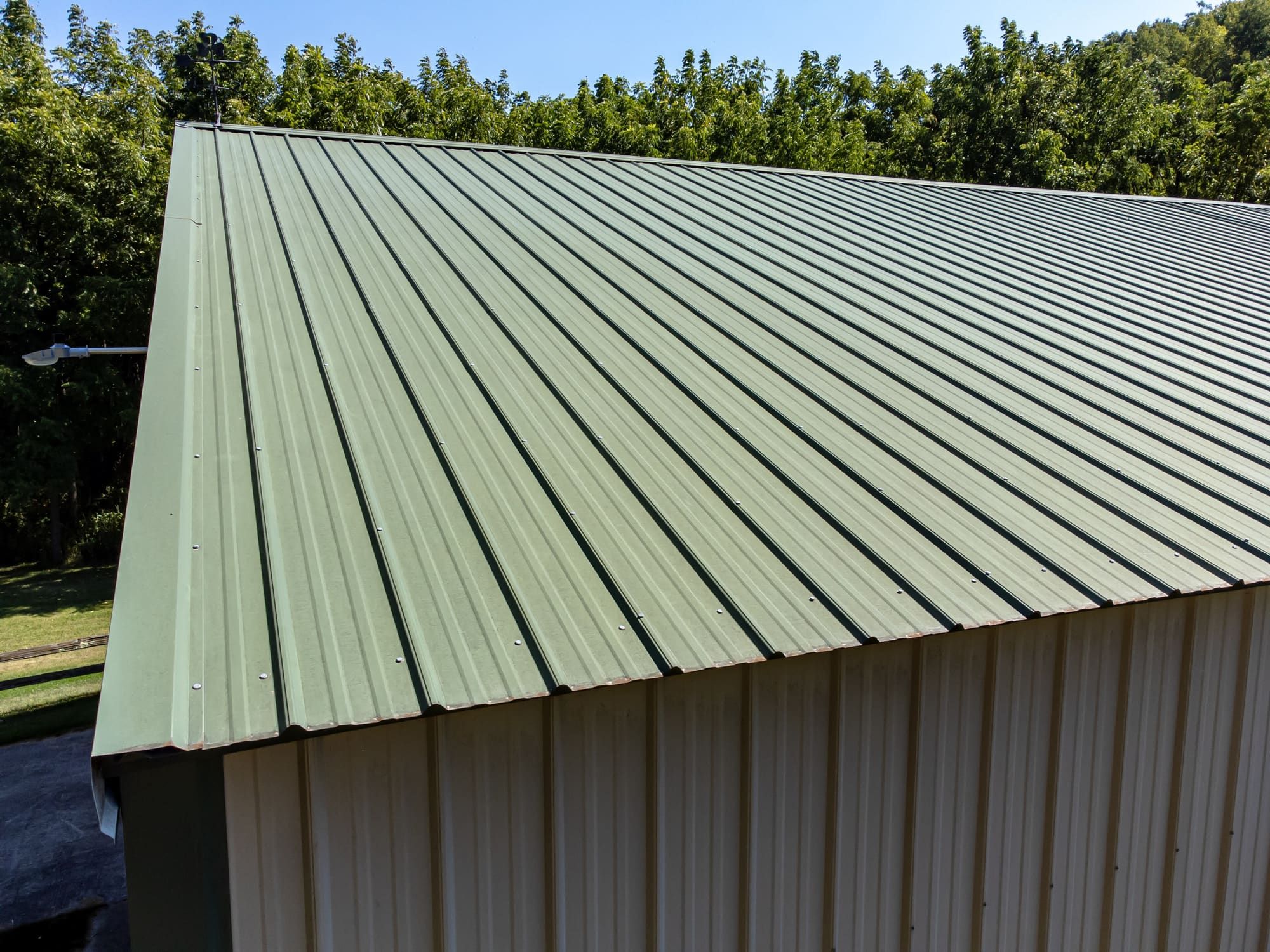
Metal Roof Repair in Chippewa Falls, WI
Most leaking steel roofs do not need new steel. They need new screws, resealed laps or a proper boot at the pipe. We find which, show you photos and price the repair in writing.
Get a Metal Roof Repair Estimate
Tell us what's going on with your roof and we'll call you back.
- Free inspections of leaking steel roofs
- Rescrews, laps, ridge caps & pipe boots
- Houses, garages, pole barns & machine sheds
Why a Metal Roof Leaks: Screws, Washers, Laps and Flashings
Steel panels last a long time. What gives out is everything that joins them and everything that pierces them, and the reason is movement.
Steel grows when it is hot and shrinks when it is cold. McElroy Metal, a panel manufacturer, publishes a movement chart for steel roof panels. Its worked example is about 1.5 inches of total movement on a 130-foot run across a 150°F change in panel temperature. Scaled down by our own arithmetic, a 40-foot shed panel moves a little under half an inch.
That swing is not unusual here. In the Wisconsin State Climatology Office's 1991 to 2020 normals for the nearby Eau Claire station, the normal January low is 5.8°F and the normal July high is 82.8°F, and a dark panel in July sun runs far hotter than the air around it. Every fastener and joint on the roof rides that movement, year after year.
Screws and washers
A screw-down roof has thousands of fasteners, each sealed by a small rubber washer under the screw head. They fail in a handful of ways:
- Sun-cracked washers. Years of ultraviolet light harden the rubber. It cracks, shrinks back from the head and stops sealing.
- Backed-out screws. Panel movement and frost in the wood rock the screw until it stands proud of the panel.
- Overdriven screws. The washer was squashed flat and split on the day it went in. Common, and it leaks early.
- Underdriven or crooked screws. The washer never sealed all the way around.
- Missed framing. A screw that missed the purlin holds nothing and leaves an open hole under its washer.
- Rusted fasteners. Once the plating is gone, the head rusts, stains the panel below it and eventually snaps.
Panel side laps and end laps
Laps shed running water. They are not built to hold standing water. On a low pitch, or where snow and ice sit on the roof, meltwater backs up and is pushed uphill into a lap that handles rain perfectly well. A lap put together without sealant tape, or with the stitch screws too far apart, opens a little more each winter.
Ridge caps and closure strips
Foam closure strips under the ridge cap fill the gaps between the ribs. They crumble with age or get pulled out by birds, and then wind-driven rain and fine snow sift straight in. A ridge leak often shows as a damp line down the middle of the building after a blizzard, not after rain.
Pipe boots, vents and stove pipes
A pipe through ribbed steel needs a boot made for it, with a flexible base that forms over the ribs and a ring of screws through the flange. A shingle-style boot or a collar of sealant does not last. Even the right boot ages: the rubber cone cracks where it grips the pipe, usually on the sunny side first.
Chimney, wall and valley flashings
Where steel meets a chimney, a wall or another roof plane, the panel ends are cut, and the trim has to cover those cuts and still let the panel move. Leaks start where trim was sealed only on the surface, where a valley was cut short, or where the uphill side of a chimney holds snow and leaves.
Cut edges, scratches and rust
The coating protects the face of the panel. Rust starts where it is broken: field-cut ends, scratches from foot traffic or a dragged ladder, and the hidden face of a lap that stays wet. It also starts under anything that holds moisture against the steel, such as leaves in a valley or needles piled against a chimney on a wooded lot near Lake Wissota.
Metal Roof Rescrew: Screw Replacement Done Properly
If a screw-down roof leaks in scattered places and the panels are otherwise sound, a rescrew is usually the right repair. It is also the one most often done badly, so this is what a proper one involves.
- Check what the screws go into. Purlins or decking have to be solid. New screws in rotted wood hold no better than the old ones did.
- Replace, do not retighten. Every old screw comes out. A new one of a larger diameter goes into the same hole so it bites fresh wood, each with a new washer.
- Drive them right. Straight, and snug enough to press the washer out to the edge of the screw head without squashing it flat.
- Deal with the orphan holes. Missed-purlin holes and torn-out holes are closed with an oversize fastener into blocking or a sealed patch. They are not left for the next rain.
- Stitch the laps. Side-lap screws that were skipped or spaced too far apart are added while we are there.
- Sweep the roof. Old screws and drill shavings left on a panel rust and stain it within weeks.
One honest limit: a rescrew resets the clock on the fasteners, not on the steel. If the panels are rusting through, it buys little, and we will say so before quoting one.
Metal Roof Repair Beyond the Screws: Laps, Ridge Caps, Pipe Boots and Panels
Each of these fixes one failed part. Which ones a building needs is what the inspection is for.
Panel laps resealed with butyl tape
A leaking lap is opened where it can be, cleaned, and resealed with butyl tape inside the joint, then stitched with lap screws at closer spacing. A bead of sealant on the outside edge is a last resort for a lap that cannot be opened, and we tell you when that is what you are getting.
Ridge cap and closure repair
The cap comes off, new closure strips matched to the panel profile go in, and the cap is refastened into the ribs. On a building that needs to breathe at the ridge, vented closures replace solid foam.
Pipe boots on ribbed panels
The old boot and every trace of old sealant come off. A flexible-base boot is formed over the ribs, sealed underneath and screwed through the flange. Where a pipe lands on a rib, the boot is sized up to span it.
Flashing rework at chimneys and walls
Surface-caulked trim is taken off and rebuilt so that water is lapped out of the joint, not glued out of it. Behind a wide chimney, that can mean adding a diverter the roof never had.
Single panel swaps
A sheet torn by wind, creased by sliding ice or rusted through can be changed on its own if a matching profile is still made. Older farm panels sometimes are not. Then the choice is a close profile across a whole roof plane or a visible mismatch on a back slope.
Rust at cut edges and scratches
Surface rust at a scratch or a cut end is cleaned back, primed and touched up with matching paint. That is spot work to slow it down. Steel that has rusted through is replaced, not covered.
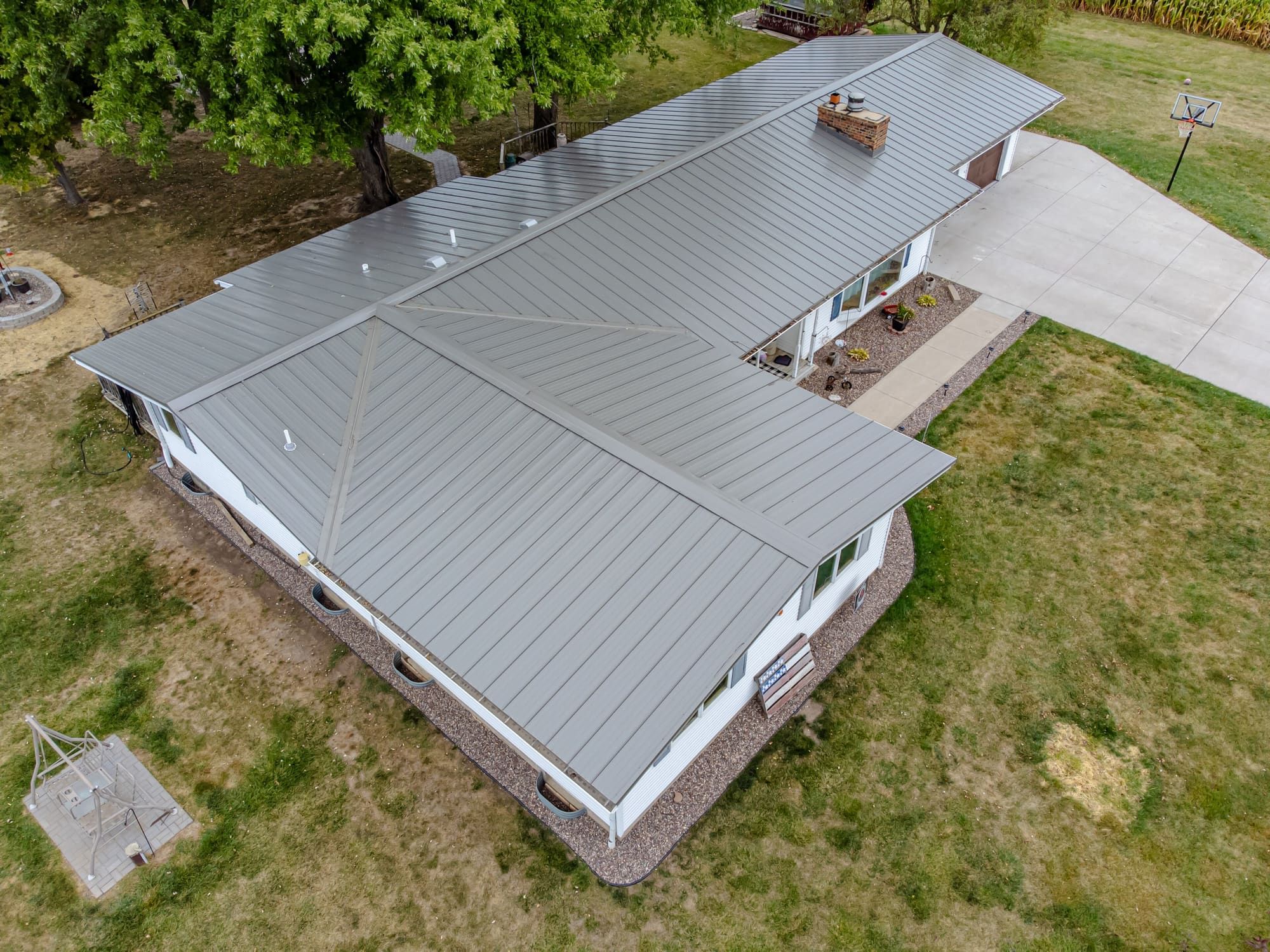
Standing Seam Repair: Penetrations, Valleys and Pinned Panels
Standing seam has no screws through the weather surface, so the usual suspects are missing. When one leaks, the cause is almost always at an edge or an opening.
- Penetrations. Pipe boots, chimneys and skylights account for most leaks on these roofs. A pipe that lands on a seam is the worst case and often needs a curb or a relocated pipe.
- Valleys and transitions. Low-slope sections and the joint where two roof planes meet hold snow and ice longest.
- Panels pinned at both ends. A panel that cannot slide buckles, pulls at its clips and works its trim loose. The fix is to free one end, not to add screws.
- Seams opened by ice. Snap-together seams near the eave can be sprung by a slab of ice letting go, or by a snow guard that was clamped on badly and dragged down the seam.
- Exposed screws in the trim. Ridge, rake and wall trim on many of these roofs is still face-screwed, and those washers age like any others.
These repairs take longer than the same job on a screw-down roof. A panel in the middle of a slope cannot simply be unscrewed. The seams on both sides have to be opened, and on a mechanically folded seam that sometimes means taking off several panels to reach one.
Two honest notes. If the roof is fairly new, read the installer's and manufacturer's paperwork before anyone else works on it, because an outside repair can affect that coverage. And if the leak traces to how the whole roof was laid out, we will tell you a patch is only buying time. How the system is meant to go together is on our standing seam metal roofing page.
Drips Under Steel Panels That Are Not a Leak: Condensation and Frost
Bare steel over an unheated or damp space sweats. Warm, moist air from livestock, a heated shop, a wet floor or stored hay meets the cold underside of the panel and condenses. In a cold snap it freezes there as frost, then lets go all at once on the first mild morning. From below it looks exactly like a roof full of holes.
| What you see | More likely |
|---|---|
| Drips across the whole building on a cold, clear morning, no rain or melt | Condensation or frost |
| Drips in rain, in the same spots each time | Screws, a lap or a flashing |
| A wet line along one purlin after a hard rain | The screw row on that purlin |
| Water at the ridge after wind-driven snow | Missing or crumbled closure strips |
| Water at an outside wall of a heated building in a thaw | Ice backing up at the eave |
| Rust streaks on the underside around the fasteners | Screws that have been leaking for a while |
We will tell you when it is condensation, even though most of the fix is not ours. Ventilation, a vapor barrier over a damp floor and getting the heat source vented outdoors do more than anything done on top of the roof. A condensation-control backing on the panels helps, but it goes on with new steel, not as a repair.
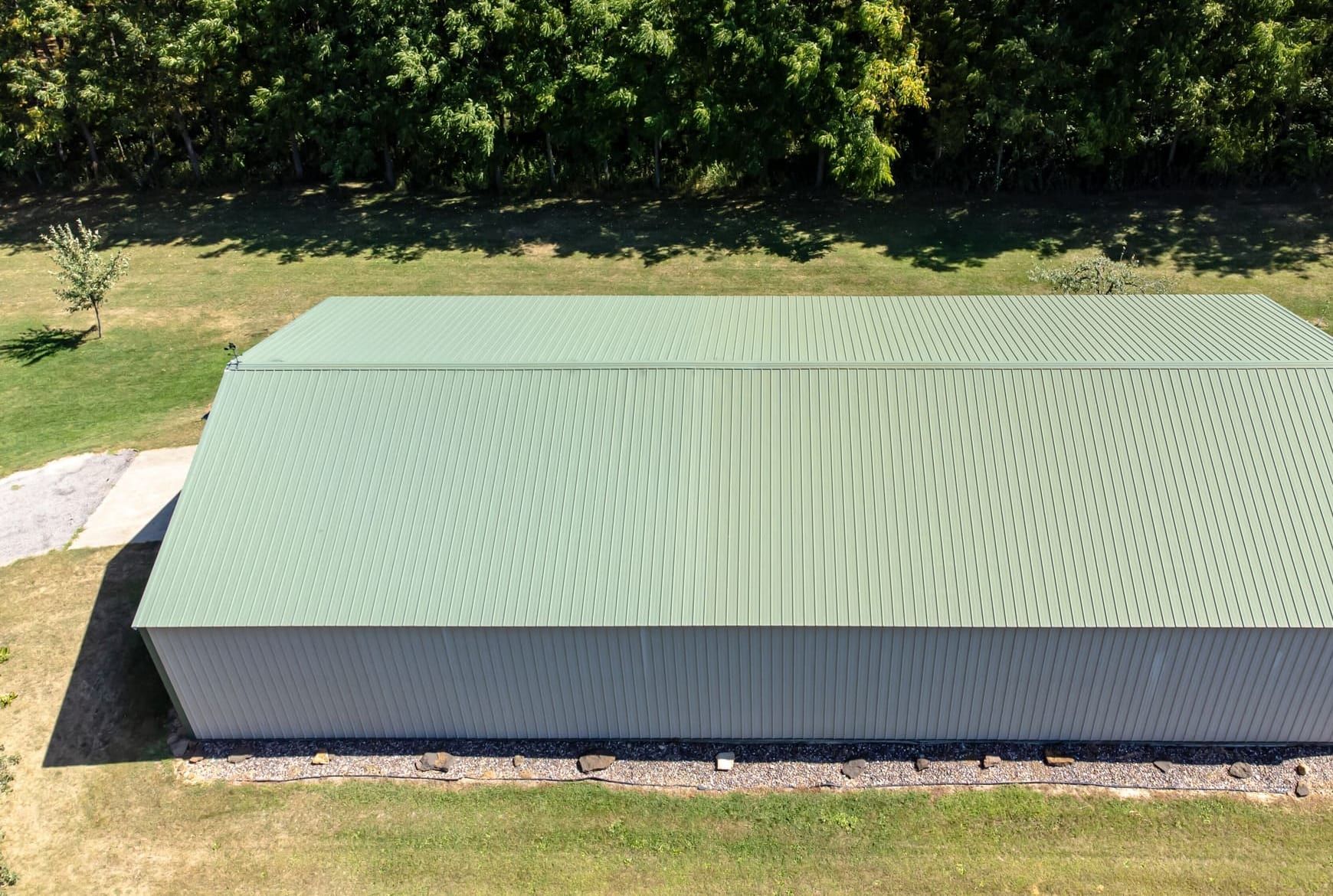
Steel Roof Repair on Outbuildings, Detached Garages and Houses Around Chippewa Falls
Steel is on every kind of building in Chippewa County, and each kind leaks in its own way.
Pole barn roof leak repair
On a pole barn the panels are screwed to wood purlins with nothing underneath, so a leak drips straight onto whatever is stored below. The usual causes are worn screw rows, screws that missed the purlin when the building went up, and a ridge that has lost its closures. We look from inside first. Daylight at a screw hole and a rust ring on the purlin show more than a walk on the roof does.
Machine sheds and shops
Wide, low-pitched roofs out in the open, around Bloomer, Cadott and Jim Falls and the townships between them. Low pitch is hard on laps, and open country is hard on edges. A sheet peeled back at the rake or eave after a summer storm is a common call. The National Weather Service recorded significant straight-line wind damage in Chippewa County on May 15, 2025. Translucent skylight panels are the other weak point: they turn brittle with age and crack around their screws.
Detached garages and lean-tos
In town and on acreages, plenty of garages are roofed in ribbed steel, some of it laid over old shingles or strapping. Leaks tend to start where a lean-to or carport ties into the main roof at a low pitch, and at the wall flashing above it.
Houses and cabins
On a heated house, steel sits over decking and underlayment, so a failed screw can leak for a long time before a stain shows. Farmhouses that were re-roofed in screw-down steel a generation ago are reaching the age where the washers go. Around Lake Wissota, tree cover adds needles in the valleys and limbs on the panels.
Height and access set the pace on tall buildings. We say so in the estimate and do not promise a date the weather can undo. New steel and full re-roofs for these buildings are on our pole barn and farm building roofing page.
Winter Damage We Repair on Steel Panels: Eave Ice, Slides and Bent Ribs
Steel sheds snow better than any other roofing, and that is most of why there is so much of it here. The same winter still does damage. Normal snowfall at the Eau Claire station is 55.4 inches a year. Its March normals, a high of 41°F and a low of 21°F, describe weeks of thawing by day and freezing again overnight.
Ice at the eaves and in valleys
A steel roof over a warm attic can still build ice. Snow melts over the heated part of the house and refreezes on the cold overhang, in a valley or behind a chimney. Meltwater then pools behind it and finds the nearest lap or screw row. Roofs with snow guards hold their snow on purpose, so they depend on a membrane under the panels at the eave and on air sealing and insulation below.
Sliding snow and ice
When a slab lets go, it takes what is in its path. We replace pipe boots and vents sheared off at the panel, refasten or replace snow guards that were torn loose, straighten or swap eave panels with creased ribs, and repair the lower roof or lean-to that caught the slide.
Freeze-thaw at laps and fasteners
Water that gets into a slightly open lap or under a lifted washer freezes, expands and opens the gap a little further. One cycle does nothing. A March full of them does.
Snow load on low-pitched sheds
Snow that does not slide stays as weight, and the weight varies far more than the depth suggests. In FEMA's Snow Load Safety Guide, twelve inches of new snow can load a roof with as little as 3 pounds on each square foot or, wet and heavy, as much as 21.
We repair leaks. We do not rate structures. A shed with a sagging ridge, a cracked truss or sliding doors that have begun to bind needs a structural engineer or the building inspector, and nobody underneath it in the meantime. Do not send anyone onto loaded or icy steel to shovel it off.
Water coming through right now is a phone call, not a form. We are open 8am–6pm. Nobody here will quote an arrival time we cannot control, since ice on the panels and the day's booked work both get a say, but you will get a straight answer about when.
What Metal Roof Repair Costs in Chippewa Falls
HomeAdvisor, a national cost guide, lists about $1,700 as its average for a metal roof repair. That is a countrywide figure for scale, not our price. A boot on a garage is far below it, and a full rescrew of a large shed is well above it.
What moves the number on a given building:
- Roof area and pitch. A rescrew is priced by area, because the count of fasteners follows it.
- How many details are rebuilt. Flashing, lap and trim work is priced by the piece.
- Height and access. A one-story garage is a ladder job. A tall machine shed may need a lift.
- Panel system. Concealed-fastener panels take longer to open up than screw-down ones.
- Matching panels. A discontinued profile or color can turn one sheet into a special order.
The honest unknown is the wood. Nobody can tell how many purlins or how much decking will hold a new screw until the old ones come out. So the written estimate states a unit price for framing and decking repair, and when the wood turns out worse than the scope allowed for, work stops until you have seen it. If the building has dripped for several winters, hold some money back for this.
On permits: inside Chippewa Falls, the city's rule is that roofing replacement needs a building permit once the estimated value of the job reaches $2,000. Many repairs come in under that line, and a full rescrew of a large building may not. Outside the city, the village, the town or Chippewa County decides. We check with the right office before work starts and tell you what they said.
Rescrew, Patch or New Steel: When Metal Roof Repair Stops Paying
We would sooner repair a sound roof than sell a new one. Repair is the right money when the paint is chalky but intact, rust is limited to a few spots, and the leaks trace to fasteners, laps or flashings. Most of the steel roofs we look at are in that group.
It stops making sense when:
- Panels are rusted through in many places, not just at one edge or one valley.
- The purlins or decking are too soft, split or full of old holes to hold a screw.
- The panels were installed on a pitch too low for their profile and have leaked at the laps since new.
- The roof has already been rescrewed once with oversize fasteners and they are backing out again.
- The repair list adds up to a large share of what new steel would cost.
When that is what we find, the written assessment says so, with photos. Often there is a middle course: fix the two or three worst details now to keep the building dry, and plan the new roof on your own schedule.
Panel systems, snow guards and what goes into a new installation are covered on our main metal roofing in Chippewa Falls page. For shingle and flat roofs, start with our main page as a roofing contractor in Chippewa Falls.
Metal Roof Repair FAQ: Loose Screws, Caulk, Panel Matching and Winter Work
Can I just tighten the loose screws on a steel roof?
Tightening helps for a season if the washer is still soft and the hole still grips. Usually neither is true. The washer has hardened and cracked, and the screw has worn its hole in the wood oversize, so it backs out again. A proper rescrew takes each old fastener out and puts in a new, larger-diameter screw with a fresh washer.
Will caulk or silicone stop a metal roof leak?
Briefly. Steel panels grow and shrink with temperature every day, and a bead of caulk on the surface cannot stretch that far for long. It cracks, and it leaves a dirty joint that the right sealant will not stick to later. Laps and trim joints are meant to be sealed with butyl tape inside the joint, where it stays flexible and out of the sun.
Are hail dents a reason to tear off steel panels?
Not on function alone. Dents that have not cracked the paint, opened a lap or flattened a seam do not make steel leak. Whether an insurer pays for dents is a policy question: some policies carry a cosmetic damage exclusion for metal. We can photograph the dents, the paint and the soft parts such as vents and pipe boots so you and your insurer have the facts.
Can you match the color and profile of one new panel?
The profile matters more than the color. Ribbed panels come in several rib spacings and heights, and a new sheet has to nest with the old ones or the lap will not seal. Color can usually be matched by name, but paint fades, so a new panel on an older building looks newer for a few years. If the profile is no longer made, we tell you before anything is ordered.
How often do the screws on a screw-down roof need attention?
There is no honest single number. It depends on the washers, how well the screws were driven, what they are driven into and how much sun the slope gets. We go by condition: washers that are cracked or squeezed out from under the screw head, heads standing proud of the panel, and rust streaks below a fastener. A walk around the building with binoculars each spring will show most of it.
Can a metal roof repair be done in winter?
Some of it. Screws can be replaced and trim refastened on a dry, clear day, with the snow and frost off the panels. Butyl tape and sealants bond poorly to cold, frosty steel, so a lap or flashing repair made in deep cold may be a temporary one that we come back to finish in spring. We tell you which kind you are getting before we start.
Do you coat or paint rusty steel panels?
No. We do not install roof coatings. A coating does not tighten a loose screw, reseal a lap or put steel back where it has rusted through, and those are the reasons these roofs leak. We clean and touch up small rust spots at scratches and cut edges as part of a repair. If you want a whole building repainted, that is a painting contractor, after the leaks are fixed.
Metal Roof Leak Repair in Chippewa Falls: Have the Screws and Laps Checked
Tell us the building, the panel type if you know it, and where the drip shows up. A photo by text helps.