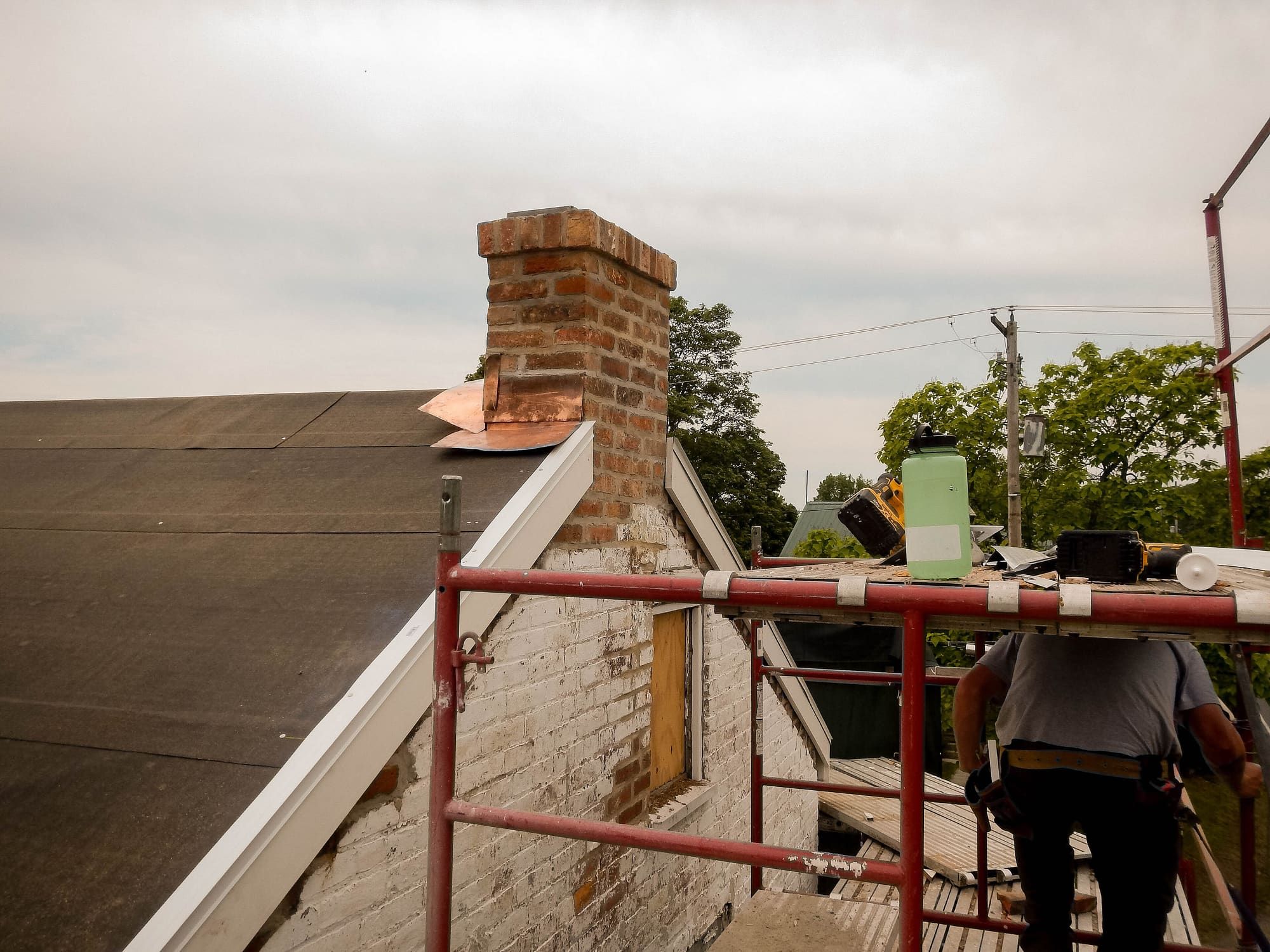
Chimney Flashing Repair in Chippewa Falls, WI
A stain beside the chimney is one of the most common leak calls on older houses, and one of the most often patched wrong. We repair and replace chimney flashing, add crickets where they belong, and tell you plainly when the leak is in the brick instead.
Chimney Leaking? Request a Flashing Inspection
Tell us what's going on with your roof and we'll call you back.
- Free chimney flashing inspections
- Photos of the flashing and the masonry
- Open 8am–6pm
Chimney Flashing Repair, Part by Part: Apron, Step, Counter Flashing and Cricket
A chimney is a brick tower standing in a hole in the roof. The roof moves with heat, cold and snow load; the chimney does not. So the two are never glued together. Overlapping pieces of metal bridge the gap, each lapped so water runs over the next one down. Four of them are roofing. Above the flashing, the chimney belongs to the mason.
- Apron flashing Roofer
One piece across the downhill face of the chimney, lying over the shingles below it and turned up the brick.
- Step flashing Roofer
Small L-shaped pieces up both sides, one woven in with each course of shingles. Each piece laps the one below it, so water that gets under a shingle is turned back out on top of the next course.
- Counter flashing in a reglet Roofer
The cover. Stepped metal let into a groove (the reglet) cut into the mortar joints and folded down over the top edges of the step flashing. Water running down the brick lands on the outside of it.
- Back pan and cricket Roofer
The uphill side, which takes everything coming down the roof. A wide pan runs up under the shingles behind the chimney; on a wide chimney a cricket, a small peaked roof, splits the water and snow around both sides.
- Brick and mortar joints Mason
Brick absorbs water and old mortar erodes. The counter flashing is only as sound as the joint it is set into.
- Crown Mason
The concrete or mortar cap over the top of the brickwork, around the flue. Cracks here let water straight down inside the chimney.
- Flue and cap Mason or chimney sweep
The liner and the rain cap on top. Water through an uncapped flue shows up at the firebox, not at the roof.
Wisconsin's Uniform Dwelling Code requires flashing at the junction of every chimney and roof, with the chimney flashed and counter-flashed to a height of at least 6 inches. When we reflash a chimney, self-adhering ice barrier membrane goes on the deck around it and up the brick behind the metal, so a leak past the flashing still meets a second layer.
Reseal, Reflash or Mason First? Choosing the Right Chimney Flashing Repair
What we find on the roof decides the repair. This is the table we work from, and the photos we send you show which row your chimney is in.
| What we find at the chimney | The repair | Why |
|---|---|---|
| Metal sound, counter flashing let into a reglet, one sealant joint at the reglet has opened | Reseal | Clean out the joint and reseal it with a sealant made for masonry and metal. A small repair, and an honest one when the flashing underneath was built right. |
| Counter flashing face-nailed to the brick and caulked along its top edge, no groove | Reflash the counter flashing | Surface-caulked flashing depends entirely on a bead of sealant on brick. A reglet is ground into the mortar joints and new stepped counter flashing set into it. |
| One long strip of metal along the side instead of step flashing | Reflash that side | A continuous strip cannot lap with the shingle courses, so water that gets under it has no way out. Shingles come off that side and step flashing goes in course by course. |
| Layers of black roof cement over the base of the chimney | Reflash | Cement from a run of patches cracks every winter and hides whatever metal is under it. Nobody can judge the flashing until it is scraped off, and by then a reflash is usually the cheaper path. |
| Rusted or pinholed metal that has outlived a roof or two | Reflash | Thin galvanized steel rusts through at the bends first. New apron, step, back pan and counter flashing, with ice barrier membrane on the deck and up the brick behind them. |
| Chimney wider than 30 inches, no cricket, leaks in snowmelt | Reflash and add a cricket | The uphill side holds snow and ice through every thaw. Framing a cricket during the reflash removes the dam instead of sealing around it. |
| Spalling brick, mortar that rakes out like sand, a cracked crown or a leaning stack | Mason first, then reflash | New counter flashing set into failing mortar fails with it. A mason repairs or rebuilds the chimney above the roof, and the flashing goes on afterward. |
| Shingles near the end of their life anyway | Temporary seal now, reflash with the new roof | Reflashing a chimney on a roof due in a year or two means paying to lift and relay shingles that are about to be torn off. |
Two things we will not do. We will not sell a tube of caulk run around the base of a chimney as a flashing repair; it is the reason so many chimneys around here have three layers of tar on them. And we will not reflash a chimney whose brick is coming apart, even though it would be the bigger invoice for us. If a reseal will do, a reseal is what we quote.
Leak Around the Chimney: Flashing Problem or Masonry Problem?
Not every leak at a chimney comes through the flashing. The Chimney Safety Institute of America goes as far as saying water causes more damage to masonry chimneys than fire does, and much of that water comes in through the brick, the mortar and the crown. Pick what you are seeing.
A stain on the ceiling or wall right beside the chimney, worse in steady rain
Where the water is getting in: Usually the step or counter flashing on one side, or the apron on the downhill face. The water enters at roof level and runs down the chimney chase.
Whose job: Roofing. We lift the shingles on that side to see the metal before quoting anything.
Water only during snowmelt, or after snow piles up behind the chimney
Where the water is getting in: The uphill side: a back pan that is too short, flat or rusted, or a wide chimney with no cricket, so meltwater ponds against the brick and backs up under the shingles.
Whose job: Roofing. A new back pan, and a cricket on a chimney wider than 30 inches.
Water in the firebox, at the damper or at a cleanout door
Where the water is getting in: Coming down the inside of the chimney: a cracked crown, an uncapped flue or a failed liner. Flashing cannot put water inside the flue.
Whose job: A mason or chimney sweep. Reflashing will not stop it, and we will say so.
Damp brick in the attic well above the roof line
Where the water is getting in: Water soaking through the brick and mortar above the roof and wicking down inside the stack. The Chimney Safety Institute of America compares common brick to a sponge.
Whose job: A mason: repointing, a crown with a proper overhang, and a cap. Then we check the flashing once the masonry is sound.
White salt deposits or flaking brick faces on the outside of the chimney
Where the water is getting in: The masonry is taking on water and drying out through the face. The salts are left behind, and freezing water pops the brick faces off.
Whose job: A mason. The flashing may be fine; we will tell you if it is.
A leak below a chimney that has been tarred over, more than once
Where the water is getting in: Somewhere under the cement, which is the problem: each patch hides the last one and traps water against the metal.
Whose job: Roofing. The cement comes off, the metal is checked, and in most cases the chimney is reflashed.
Drips only in wind-driven rain from one direction
Where the water is getting in: Either the counter flashing joint on that face or the masonry above it. Rain driven sideways gets behind loose counter flashing and through open mortar joints alike.
Whose job: Often some of each. A water test one face at a time separates them, and we price only the roofing part.
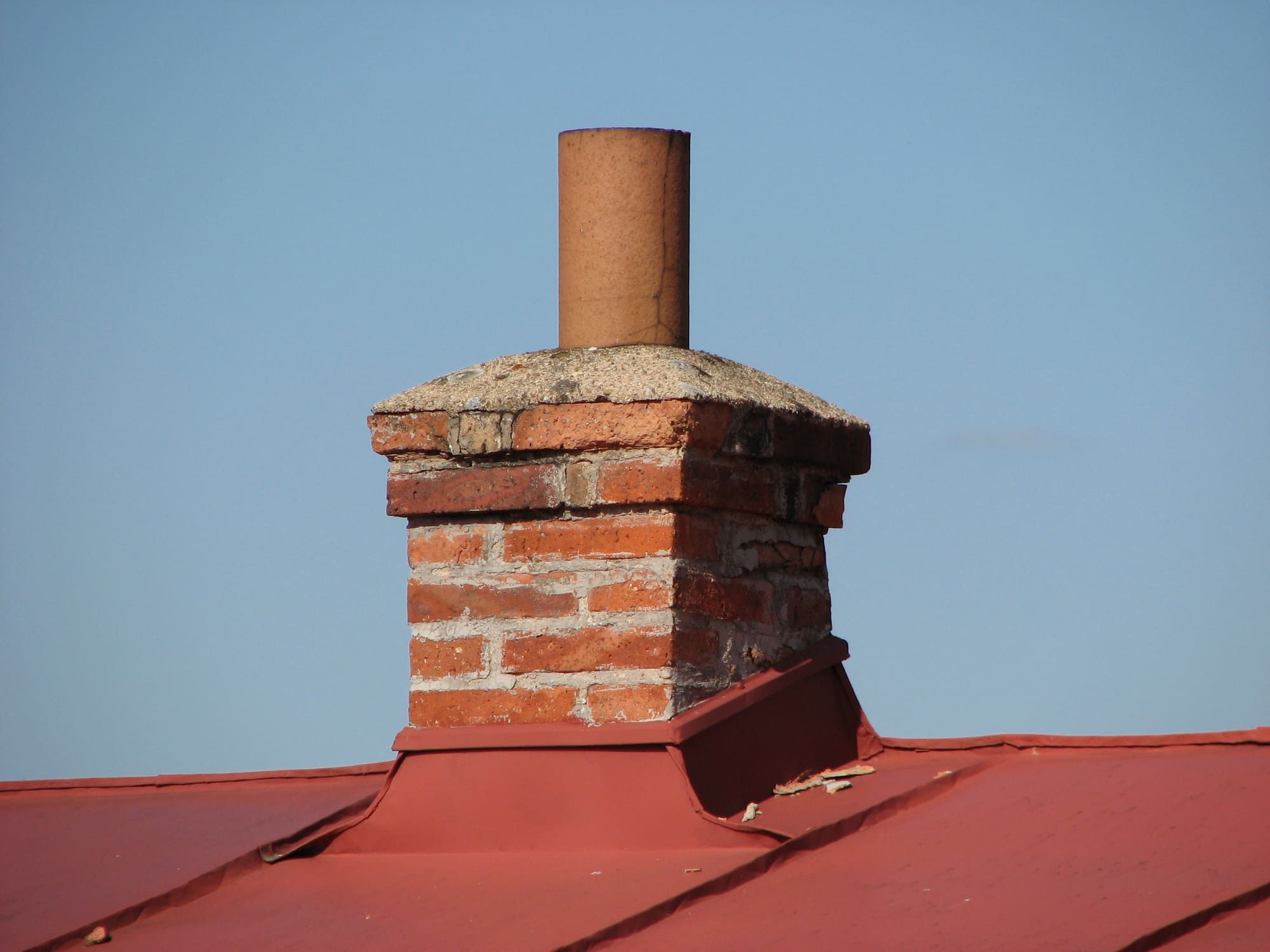
CSIA's own advice for the top of the chimney is a crown that overhangs every side by about two inches and a well-fitted cap. Both are mason's work. In the photo, the base flashing is still doing its job; the crown, the joints and the flue tile are what failed.
If the stain is nowhere near the chimney and the source is a mystery, start with our page on roof leak repair, which covers how a leak is traced back to where it enters.
Chimney Crickets: When Wisconsin Code Requires One and How Tall It Should Be
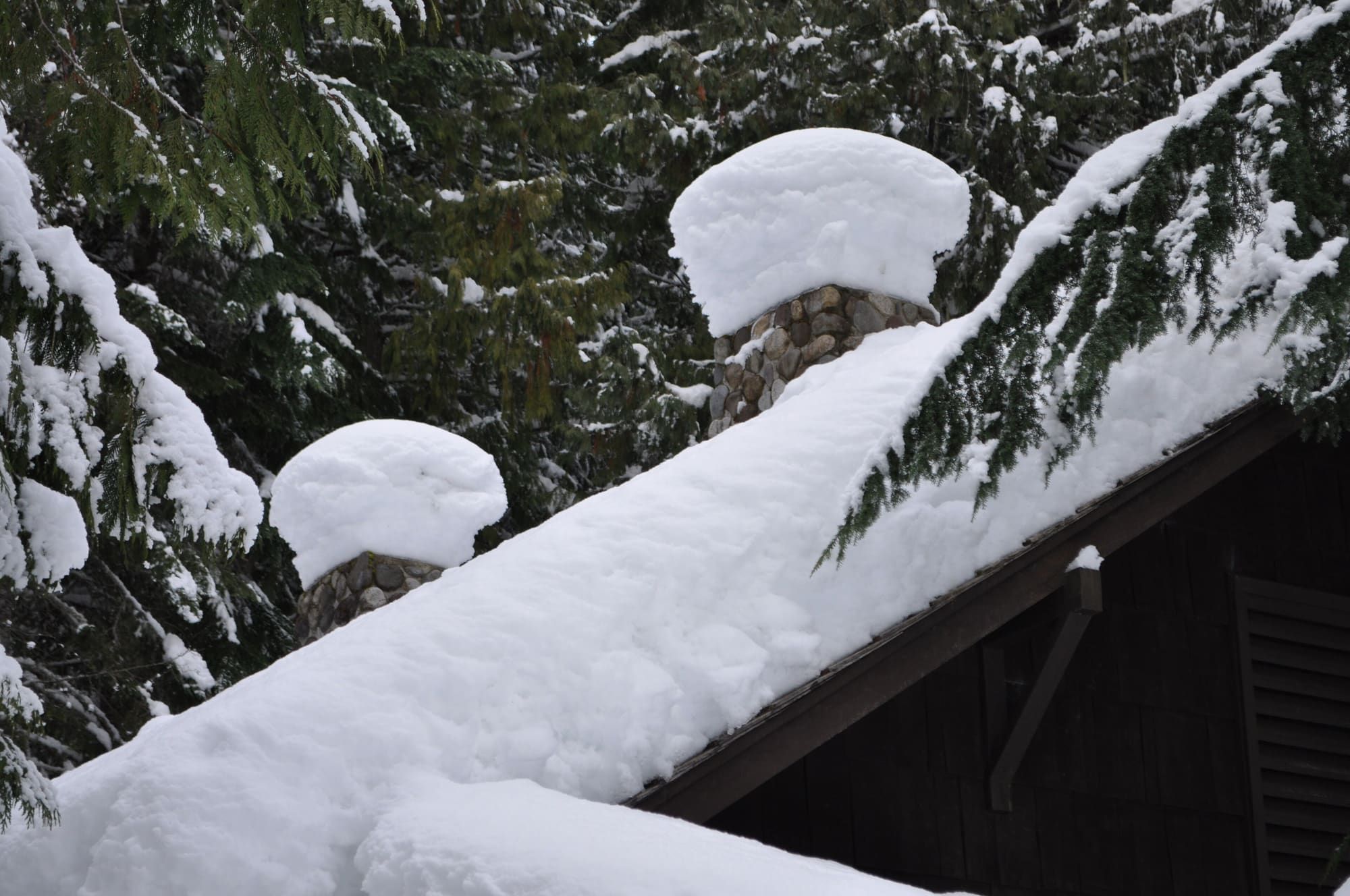
Everything coming down the roof meets the uphill face of the chimney: rain, meltwater, leaves, and in a Chippewa Valley winter, a drift of snow that sits there for weeks. A cricket, also called a saddle, is a small peaked roof framed against that face so water and snow split and run around both sides.
Wisconsin's Uniform Dwelling Code calls for a cricket where the upper side of a chimney is more than 30 inches wide, flashed and counter-flashed to the chimney like the rest. The UDC is Wisconsin's own code and covers houses built since June 1, 1980. Many chimneys in town are much older, and a wide one with no cricket is one of the first things we look for.
Cricket quick check
Wisconsin's code does not say how tall a cricket must be. The International Residential Code, the national model code for houses, does, in Table R1003.20, and we use it as the guide:
| Roof pitch | Height (IRC) | 36-in chimney |
|---|---|---|
| 12 in 12 | 1/2 of the width | 18 in |
| 8 in 12 | 1/3 of the width | 12 in |
| 6 in 12 | 1/4 of the width | 9 in |
| 4 in 12 | 1/6 of the width | 6 in |
| 3 in 12 | 1/8 of the width | 4.5 in |
By our arithmetic those ratios are simply a cricket pitched the same as the roof, which is how the quick check works out pitches between the table's rows. The IRC also leaves out a chimney that comes through the ridge, which already sheds water both ways. Adding a cricket during a reflash or a new roof is modest framing, decking and flashing, and it removes the place where ice sits longest.
Why Freeze-Thaw Opens Chimney Flashing on Chippewa Valley Homes
Flashing rarely fails in one storm here. It is worked loose a little at a time, by water that gets into a joint, freezes and pries it wider.
- 162.9
- days a year with a low at or below 32°F at Eau Claire, NOAA 1991 to 2020 normals
- About 89
- days a year that freeze at night and thaw by day (our arithmetic from the same normals)
- 55.4 in
- of snow in a normal season, and the uphill side of a chimney collects more than its share
- The reglet joint. Water that gets into the joint where counter flashing enters the mortar freezes and expands. Each cycle opens it a little further and loosens the mortar holding the metal.
- Surface sealant. Caulk on brick stiffens in the cold (the normal January low at Eau Claire is 5.8°F) and pulls away from the brick as the chimney and the metal move at different rates.
- The mortar itself. Old soft mortar soaks up water and crumbles as it freezes. Once it recedes, the counter flashing has nothing to grip.
- Snow behind the chimney. A drift against the uphill face melts against the warm brick by day and refreezes by night, feeding water into the back pan for weeks. That is why so many chimney leaks show up in March, not in July storms.
The same cycle is behind ice dams at the eaves, and the two are easy to confuse when the stain is near an outside wall. If the water is at the edge of the roof, not beside the chimney, our page on ice dam roof repair covers that leak.
Older Chippewa Falls Chimneys: West Hill, Downtown Blocks, Farmhouses and Lakeshore Stone
The West Hill Residential Historic District, on the bluff over the Chippewa River just west of downtown, holds 162 houses built between 1870 and 1958, from lumber-era Italianate and Queen Anne houses to bungalows and a few postwar ranches. It was added to the National Register of Historic Places in 2021. On streets like those, and on the older blocks around downtown, a chimney may have outlived several roofs.
What turns up when we look closely at those chimneys:
- Flashing that stayed put through two or three reroofs. It is quicker to tuck new shingles against old metal and seal the edge than to reflash, so many crews did exactly that.
- Counter flashing nailed to the face of the brick and caulked along the top, never let into the mortar.
- Wide chimneys low on a long slope with no cricket, built for coal or wood furnaces long before any code asked for one.
- Chimneys that no longer serve anything, left standing after the furnace moved to a sidewall vent, still taking on rain.
Out toward Bloomer, Cadott and Jim Falls, farmhouses often have a brick chimney on the original house and a newer one, or none, on each addition, and the flashing ages at different rates. Cabins around Lake Wissota may have a stone or block chimney under tall pines; needles pack in behind it and keep the back pan wet, and stone's uneven joints make counter flashing harder to seat.
A note for owners of older houses: National Park Service guidance is that listing on the National Register places no restrictions on what a private owner does with a house paid for privately, though state or local rules can still apply. Before a chimney that shows from the street is taken down, we check with the city.
Reflashing a Chimney Now or Waiting for the Next Roof?
A full reflash means lifting the shingles around all four sides. On a roof with years left, that is money well spent. On a roof that is nearly done, it can be money spent twice.
When the chimney should not wait
- The shingles around it are flexible and have years left.
- Water is reaching the deck: soft wood, rusty nails or stained rafters in the attic beside the chimney.
- The flashing was built wrong (face-nailed, one long strip, no back pan), so no seal will hold.
- The chimney is wide, has no cricket and leaks every spring.
When to seal the chimney flashing for now
- The roof is due within a year or two, and lifting brittle shingles would break them.
- The leak is slow, the deck is still sound and you can watch it.
- The masonry needs a mason first, and the schedule allows it before the new roof.
- You are deciding whether to take an unused chimney down; there is no point reflashing one that is coming out.
Hold back for the deck. On a chimney that has leaked for years, the plywood or boards around it are often soft, and nobody can see how far until the shingles are off. We price decking per sheet in writing and show you what comes out; keep 10 to 15 percent in reserve for it.
Roof Flashing Repair Beyond the Chimney: Sidewalls, Dormers and Skylights
Anywhere a roof runs into something vertical is flashed on the same principle: step flashing woven into the shingles, covered from above. On a wall, the siding and its housewrap do the counter flashing's job. These go wrong in a familiar pattern.
- Sidewalls and dormer cheeks. Step flashing left out behind vinyl or reused at the last reroof, and siding run tight to the shingles so it wicks water and hides rotted trim.
- The bottom of a wall that ends on a roof. Water running down the step flashing needs a kick-out piece to throw it clear of the wall. Without one it runs behind the siding and rots the corner.
- Skylights. Most leaks blamed on the skylight are its flashing, or in winter, condensation on the glass. An old unit with failed seals is usually better replaced with new flashing than reflashed around worn glass.
The repair is the same as at a chimney: shingles lifted, new step flashing course by course, membrane behind it, and the siding or trim above it refit so it laps over the metal.
What Chimney Flashing Repair Costs in Chippewa Falls
For scale only: HomeAdvisor's national figures put roof flashing repairs at about $200 to $500. That fits a reseal or a small repair on one side. A full chimney reflash, with shingles lifted on all four sides, a new reglet, apron, step flashing, back pan and counter flashing, membrane, and a cricket where one is needed, costs more. Those are national averages, not our prices.
What moves the number on a given chimney: its width and height, the roof pitch and how easy it is to work around, whether a cricket has to be framed, how many shingles break when lifted, and how much decking is soft underneath.
Permits: the City of Chippewa Falls requires a building permit for roofing replacement work unless the estimated value is under $2,000. Most chimney reflashing comes in under that line; when one comes close, we check with the inspection office before work starts. Outside the city we check with the town, village or county.
Chimney flashing is one part of our roof repair work in Chippewa Falls, which also covers missing shingles, pipe boots, valleys and vents. For a new roof, metal or flat roofing, start on the main page of our work as roofers in Chippewa Falls.
Chimney Flashing FAQ: Sealant, Crowns, Reglets and Unused Chimneys
Is roof cement or caulk an acceptable chimney flashing repair?
As a stopgap until the weather allows a proper repair, yes. As the repair, no. Sealant smeared on brick cracks within a few freeze-thaw seasons, and a thick coat of roof cement hides the flashing so nobody can tell what is underneath. The one legitimate sealant repair is resealing the joint where sound counter flashing enters a groove in the mortar.
Can new chimney flashing go in without a new roof?
Yes, as long as the shingles around the chimney are flexible enough to lift and relay. We remove a few courses on each side, install the new flashing and put the shingles back, replacing any that break. On an old, brittle roof the shingles crack when handled and the job grows. If the roof is due within a couple of years, it is usually smarter to seal it for now and reflash as part of the new roof.
Do you repair chimney crowns, caps or brickwork?
No. We replace the flashing and the roofing around it. Repointing mortar, rebuilding a crown, relining a flue, fitting a cap and sweeping are work for a mason or a chimney sweep. When the water is coming through the masonry, we tell you so and suggest you call one of them before you spend anything with us.
What is a reglet, and does every chimney need one?
A reglet is a narrow groove cut into a mortar joint so the top edge of the counter flashing can be tucked into the masonry instead of lying on the face of the brick. On a brick chimney it is the standard way to fasten counter flashing. On a stone chimney with irregular joints the counter flashing is often scribed to the stone and sealed, which needs more frequent checks.
Can chimney flashing be repaired in winter?
Sometimes. On a dry day with the roof clear of snow and ice, a chimney can be reflashed, though shingles have to be sealed by hand in the cold. When the area behind the chimney is packed with ice, we make it as watertight as we safely can and come back for the permanent repair once it melts.
What should be done with an old chimney that is no longer used?
Two choices. A mason can take it down below the roof line, after which the opening in the roof is decked and shingled over, which removes the leak point for good. Or it stays, in which case it still needs sound flashing and a cap, because an unused chimney takes in as much rain as a working one. On an older house, check with the city before removing a chimney that shows from the street.
How long should chimney flashing last?
Properly lapped metal flashing set into the mortar should last as long as the roof around it, and often longer. What wears first is any sealant joint and the mortar the counter flashing sits in. Looking at both every few years, and after a hard winter, is cheaper than finding out from a ceiling stain.
Find Out Whether Your Chimney Leak Is Flashing or Masonry
Call or text a photo of the chimney and the stain. We will check the flashing, the shingles around it and the brick above, and tell you in writing which one is letting water in.