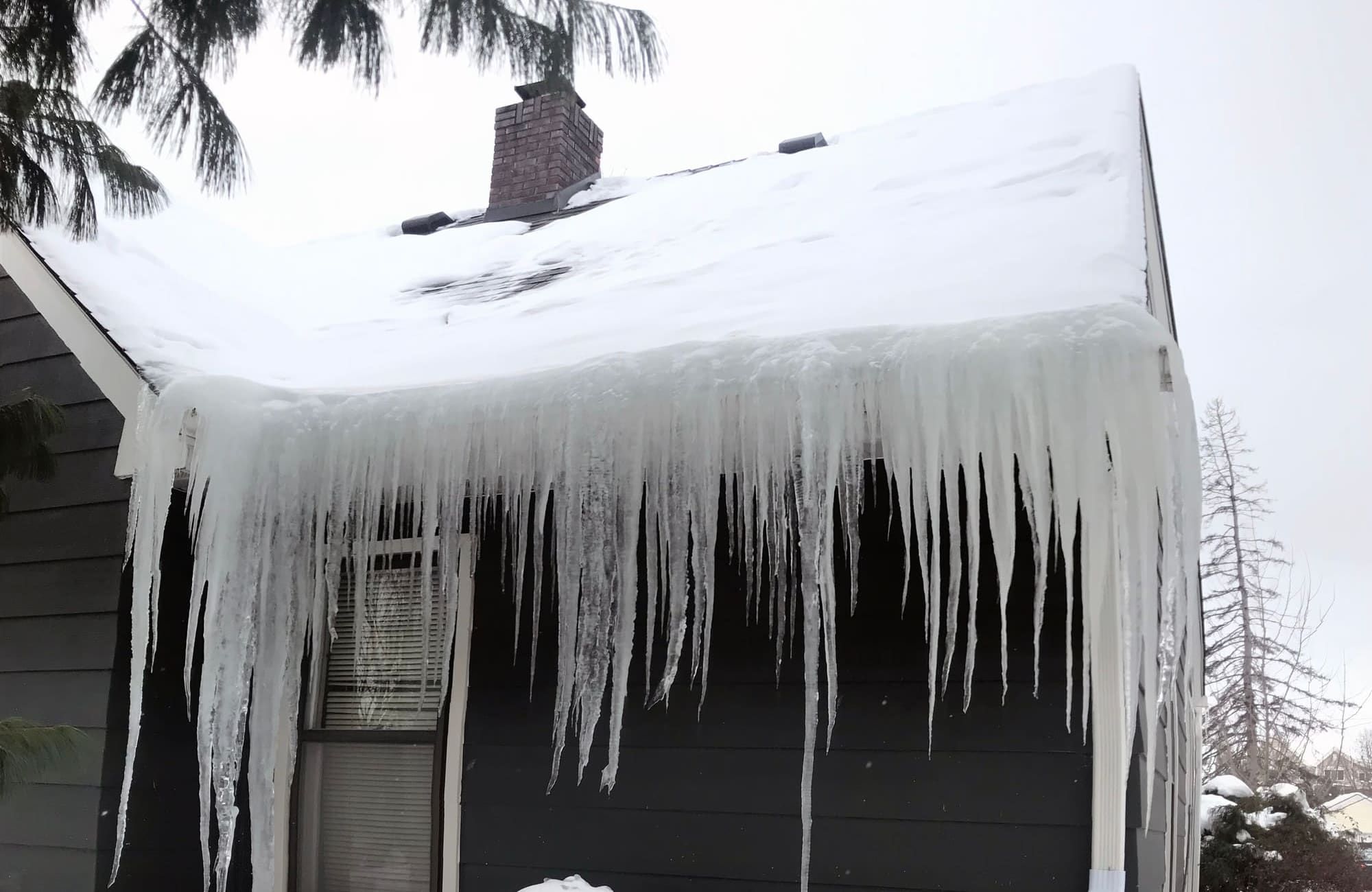
Ice Dam Roof Repair in Chippewa Falls, WI
Water at an outside wall in the middle of winter, and a ridge of ice along the eave above it. We repair the eave shingles, decking and drip edge an ice dam damages, and we tell you plainly how much of the cure is roofing and how much is attic.
Ice Dam Leaking? Request an Inspection
Tell us what's going on with your roof and we'll call you back.
- Free inspection of the roof and the attic
- Eave repairs priced in writing after the thaw
- Open 8am–6pm
Ice Dam Leaking Into the House? What to Do While It Drips
Nobody can repair an eave under two feet of ice, us included. For now the aim is to limit the damage indoors and take the pressure off the dam.
Steps that limit the water damage
- Catch it and move things. Buckets, towels, furniture and electronics out of the way. If a ceiling is bulging with water, a small hole at the lowest point drains it into a bucket. A controlled hole is better than a collapsed ceiling.
- Photograph before you clean up. The ice outside, the stains inside, with dates. Wisconsin's insurance commissioner asks for photos of the damage before cleanup begins.
- Rake the lower roof from the ground. The commissioner's office suggests safely raking snow off the first one or two feet of roof with a roof rake. University of Minnesota Extension notes a rake can damage shingles too, so pull gently and leave a skim of snow.
- Keep the attic cold. Close the attic hatch, and if a bath fan duct has come loose up there, reconnect it. A colder attic means less melting.
- Keep people clear of the eave. A falling slab of ice is heavy enough to hurt someone.
Things that make an ice dam leak worse
- Do not climb onto the roof. An icy roof in winter is where people get hurt, and the state's advice is to work from the ground.
- Do not chip, hammer or chop the ice. The commissioner's office warns that chipping damages the roof and the shingles.
- No pressure washer, torch or heat gun. Experts quoted by WEAU in February 2019 said not to use a pressure washer or chip the ice off with a pick or shovel; open flame near the roof edge is worse.
- Go easy on chemicals. Minnesota's Department of Commerce says chemicals, like chippers and heat, can damage shingles and other parts of the house.
- Do not count on a channel. A channel hacked through the dam drains it for a few days at most; Extension calls it a temporary solution that soon stops working.
We are open 8am–6pm. Call (715) 233-8665 or text a photo and tell us what you are seeing. In mid-winter we inspect, photograph and advise, and schedule the permanent repair for when the eave is clear of ice. If water is pouring in rather than dripping, say so when you call.
Ice Dam Roof Repair Once the Ice Is Gone: Shingles, Membrane, Decking and Fascia
Once the ice is gone and the roof is dry, the eave can be opened and the real extent seen. This is the roof edge from the outside in: what the ice did to each layer and how we repair it.
-
Eave shingles
What the ice didWater backed up under the first few courses, through the nail holes and the laps. Ice lifts and cracks the tabs, and shovels and roof rakes scrape off granules or tear the edges.
The repairThe lower courses come off along the affected run of eave, usually the first three to six feet up the slope, so the layers underneath can be seen. New shingles go back on and are sealed by hand if the weather is cool.
-
Underlayment and eave membrane
What the ice didFelt that sat under standing water for weeks wrinkles, tears and stops shedding. Older roofs often have no membrane at the eave at all, or a strip that stops short of the warm wall.
The repairSelf-adhering ice barrier membrane goes on the bare deck, run far enough up the slope to pass well inside the heated wall, with synthetic underlayment above it.
-
Drip edge metal at the eave
What the ice didIce expanding at the very edge pushes drip edge out or bends it, and water running behind it rusts the nails and soaks the top of the fascia board.
The repairNew drip edge, lapped with the membrane so water running off the roof stays on the outside of the metal and away from the wood.
-
Roof decking along the edge
What the ice didPlywood or OSB that stays wet goes soft and delaminates, worst over the overhang. On older houses with board decking, single boards rot at the ends or split around the nails.
The repairSoft sheets or boards are cut out and replaced to solid framing. You get the per-sheet price in writing before the work starts, and we show you each piece that comes out.
-
Fascia boards and soffit
What the ice didMeltwater running down the back of the fascia rots the board from behind, and ice can pack the soffit vents shut. A gutter pulled down by the ice often comes with it; that is a separate trade, and we leave the fascia sound for whoever rehangs it.
The repairRotted fascia boards and damaged soffit at the roof edge are replaced as part of the eave repair and priced on their own line, so you can see what the carpentry adds.
-
Ceilings, walls and insulation inside
What the ice didWet attic insulation flattens and stops insulating, which makes the next dam worse. Drywall at the top of outside walls stains, blisters or sags.
The repairNot our work. Wet insulation is for an insulation contractor, drywall and paint for a drywall finisher or painter. We tell them what we saw from the attic so they know where to start.
Most ice dam roof repair is a strip along one or two eaves, not a new roof. The exception is a roof that was near the end of its life anyway; then we price the eave repair and a replacement side by side, so you can see which makes sense. Older roofs surface surprises once the shingles are off, so hold back 10 to 15 percent for decking you cannot see today.
Where an Ice Dam Leak Shows Up Inside, and What It Points To
Where the water appears says a lot about what is happening at the roof. Pick the spot that matches yours.
Water at the top of an outside wall or a ceiling corner
At the roof: The classic ice dam leak. Water pooled behind the ice at the eave, worked up under the first few courses of shingles and ran down the inside face of the wall. The stain usually sits within a foot or two of the wall.
What we check: The eave directly above: how far up the shingles were wet, whether there is any membrane under them, and the decking at the overhang. Then the attic over that wall, where the insulation is usually thinnest.
Water dripping from the top of a window or door
At the roof: Water that got in at the eave ran down inside the wall cavity and came out at the first opening it met. The window gets the blame, but in mid-winter with ice above it, the window is usually just the exit.
What we check: The eave above the opening before anyone replaces a window. If the window head flashing is also bad, we will say so, but most of these are roof water.
A ceiling stain several feet in from the outside wall
At the roof: Water got well past the wall line. That points to a big dam on a low-pitch section, an eave with no membrane at all, or a valley above. It can also be attic frost melting on a sunny day, which is a different problem.
What we check: The roof above the stain and the underside of the deck in the attic. Frost on nail tips or a damp, even layer across the sheathing means warm, moist air in the attic, not a hole in the roof.
A stain below a valley, dormer or porch tie-in
At the roof: Valleys collect snow from two slopes and fill with ice first. Where a lower porch or addition roof meets the house wall, meltwater from above freezes on the colder lower roof and backs up against the wall flashing.
What we check: The bottom of the valley, the step flashing at the wall and how much membrane is under both. Low-pitch tie-ins often need membrane over their whole surface. If the water is beside a chimney instead, see chimney flashing repair.
Water on a sloped ceiling or knee wall upstairs
At the roof: Story-and-a-half houses and vaulted ceilings have the ceiling fastened to the rafters, with little room for insulation or air between it and the roof. Heat melts snow mid-slope, and the dam forms higher than on an ordinary attic.
What we check: The full height of the slope, not just the eave, and the knee-wall spaces behind the upstairs rooms, where the insulation is often thin or missing.
A leak with no ice at the eave, or one that also shows in rain
At the roof: Then it is probably not an ice dam. A leak that shows up in summer storms as well as in thaws is a flashing, boot or shingle problem somewhere on the roof.
What we check: We trace it from the stain back to where the water gets in, which can be some distance away. Our roof leak repair page explains how we trace a leak to its source.
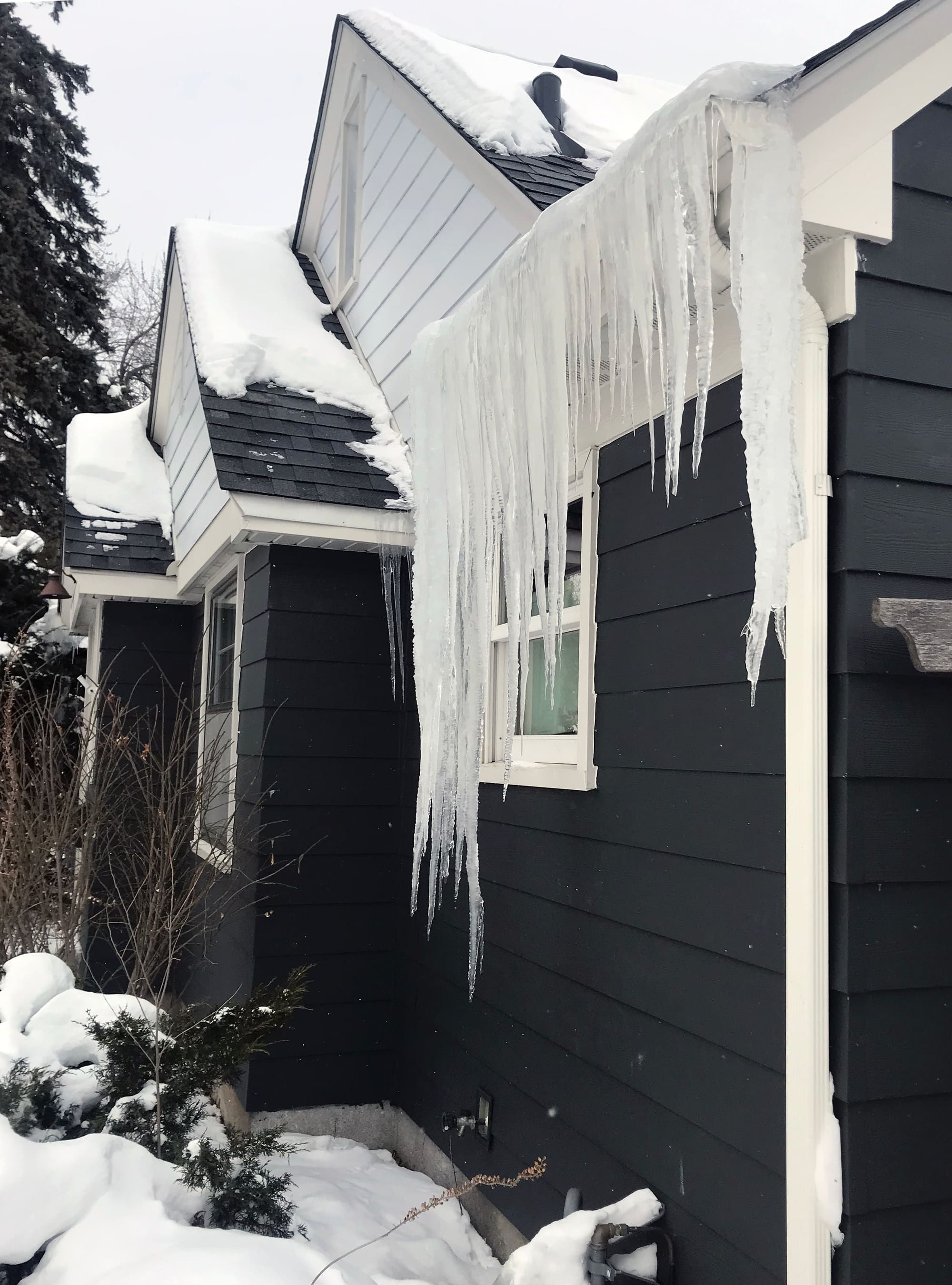
Why Ice Dams Form on Chippewa Falls Roofs: Heat Loss Into the Attic
An ice dam is a heat problem that shows up as a roof problem. University of Minnesota Extension puts it simply: heat loss from the house, snow cover and outside temperatures interact to form ice dams. The sequence is the same on every house:
- Warm air and heat leak from the living space into the attic and warm the roof deck above freezing.
- Snow on the warm part of the roof melts from underneath, and the water runs down under the snowpack.
- It reaches the overhang, which sits outside the heated wall and stays cold, and freezes there.
- Water now pools behind the ice. Shingles are made to shed running water, not to hold back a pond, so it works up under the laps.
Wisconsin's insurance commissioner notes that when snow melts during the day and refreezes at night, ice dams can form very quickly. And the largest source of the heat is usually air, not missing insulation: Extension calls air leakage into the attic the major mode of heat transfer behind ice dams in many homes.
So here is the admission that costs us work: new shingles do not stop ice dams. A roofer who says a new roof alone will end them is selling shingles. What we can do from the roof is keep the water out when a dam forms, which is worth doing, and point you to the attic work that keeps the dam from forming.
Snowpack to Spring: How an Ice Dam Leak Builds Over a Chippewa Valley Winter
Ice dams are not a single cold night. They build over a winter, and the figures for the Eau Claire station, the nearest long-term record to Chippewa Falls, show why this valley gets so many.
- December Snow settles in
The first snow that stays. Heat leaking from the house warms the roof deck above the living space, and the snow starts melting from underneath.
- Cold snaps The ridge of ice grows
Meltwater runs down under the snow to the overhang, which has no heat under it, and freezes. The normal January low at Eau Claire is 5.8°F, so the edge stays frozen for weeks.
- Freeze-thaw days Every cycle adds ice
By our arithmetic from NOAA normals, about 89 days a year at Eau Claire drop below freezing at night and climb above it during the day. Each one melts a little more and freezes it at the edge.
- Deep snow More blanket, more melt
Snow insulates the deck beneath it, so a deep snowpack melts faster from below. Normal snowfall at Eau Claire is 55.4 inches a season.
- The leak Water backs up
Water pools behind the ice, on top of the warm part of the roof, and creeps up under the shingle laps. Stains show at the tops of outside walls and around windows.
- March Peak leaking
Normal March highs at Eau Claire reach 41°F and lows fall to 21°F: a melt most afternoons and a freeze most nights, which is why so many ice dam leaks show up late in the winter.
- Spring Open and repair the eave
Once the ice is gone and the roof is dry, the eave can be opened, the damage measured, and the shingles, membrane, drip edge and decking replaced.
- Before next snow Fix the heat loss
Summer and fall are when the attic side gets done: air sealing and insulation from inside. It is the step that decides whether the dam comes back.
The bad winters are the deep ones. The 2018 to 2019 season set Eau Claire's record at 98.8 inches of snow, with 53.7 inches in February 2019 alone, the snowiest month on the station's record. That month WEAU reported ice dams forming on roofs around the area and damaging homes inside and out, with water leaking into living space.
How to Stop Ice Dams Coming Back: Roof-Side and Attic-Side Fixes
Two kinds of work, usually by two different trades. One stops the dam from forming. The other keeps the water out when one forms anyway. Most houses that dam every winter need some of both.
Attic side: what stops the dam forming
- Air seal the attic floor first. Extension's first step is to make the ceiling airtight so no warm, moist air flows into the attic: gaps at the hatch, recessed lights, plumbing and wiring holes, chimney chases and the tops of interior walls.
- Then insulate, evenly, and especially over the outside walls, where the roof comes down close to the ceiling and the insulation is thinnest, directly under where dams form.
- Vent exhaust fans outdoors. A bath fan blowing into the attic can melt a stripe up the roof by itself.
Minnesota's Center for Energy and Environment calls air sealing and insulating the attic the best solution and puts the typical cost at $1,000 to $4,500. That is a Minnesota figure, not ours, and we do not do this work.
Roof side: what keeps the water out
- Ice barrier membrane at the eaves, run past the inside line of the heated wall, plus valleys and low-pitch tie-ins. On roofs of 4-in-12 or less over heated space, Wisconsin's dwelling code requires ice dam protection at least 30 inches up from the edge and 12 inches past the inside face of the exterior wall. Steeper roofs are not covered by that rule, so an older steep roof may have only felt at the eave.
- Drip edge and sound decking at the overhang, so the edge sheds water instead of soaking it up.
- Balanced passive ventilation when the roof is open: clear soffit intake and a ridge vent, so whatever heat still gets through is carried off.
What we will not sell you for ice dams: heat cables, or powered attic fans and extra roof vents, which Minnesota's Department of Commerce says will not eliminate ice dams and often make them worse.
When it is not a roofing job. If the roof is sound and the leak came from one big dam in a heavy winter, the best money may go to air sealing and insulation, not to us. If the eave decking is solid and the stain dried out, there may be nothing on the roof to fix. We will tell you that after the inspection, even though it means no roofing work.
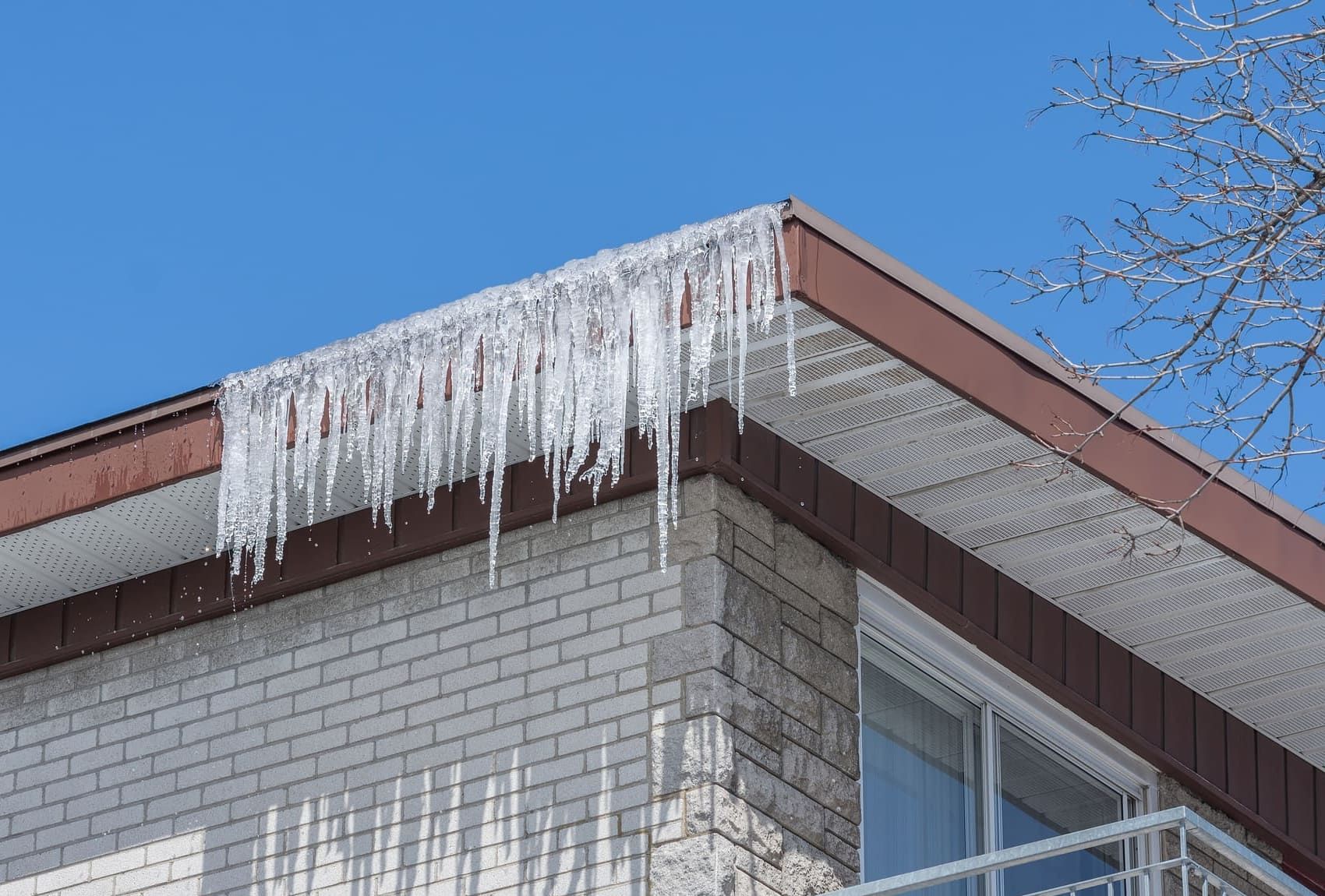
Ice Dam-Prone Houses Around Chippewa Falls: Story-and-a-Halfs, Additions and Lake Cabins
Some houses dam every winter while the neighbors never do. The difference is the building.
- Story-and-a-half and Cape Cod-style houses. Common among the older homes near downtown and along the Chippewa River. The upstairs rooms are built into the roof, with short knee walls and sloped ceilings fastened to the rafters, which leaves little room for insulation and air. Their eaves ice up heavily, and the leaks show on the sloped ceilings upstairs.
- Additions and porches tied into the main roof. A low-pitch roof over a family room or heated porch, often with a vaulted ceiling, meets the main house at a wall. Meltwater from the steep roof above freezes on the flatter one below.
- Mid-century ranches. Lower pitches hold snow longer, and the attic gets very shallow over the outside walls, where insulation is thinnest.
- Newer homes with complex roofs. Subdivision houses in Lake Hallie and on the edges of town often have valleys, dormers and recessed lights that the plainer older roofs do not, and each one is a place for heat to escape or ice to collect.
- Lake cabins and shaded eaves. Around Lake Wissota a north eave under tall pines may see little sun all winter, so ice that forms stays. A seasonal place kept at low heat can still dam over a warm spot, and the leak can run for weeks before anyone opens the door.
- Farmhouses with additions. Out toward Bloomer, Cadott and Jim Falls, older farmhouses often carry several additions built in different decades, each with its own roof pitch and insulation, and the ice finds the joins.
What Ice Dam Roof Repair Costs in Chippewa Falls
For scale, HomeAdvisor's national figures put minor roof repairs at about $100 to $1,000, the average roof repair at about $1,174, and roof leak repairs at about $360 to $1,550. Those are national averages, not our prices. An ice dam repair is priced once the ice is gone and we have seen how far the damage runs.
What moves the price: how many feet of eave have to be opened, how many sheets or boards of decking are soft, whether fascia and soffit need replacing, how far up the slope the new membrane runs, and how steep and tall the roof is.
Permits: the City of Chippewa Falls requires a building permit for roofing replacements unless the estimated value is under $2,000. A strip of eave is often under that line, but not always once decking and fascia are added; that is our reading, not the city's wording, so we check with the inspection office when a repair comes close. Outside the city we check with the town, village or county.
Ice dam damage and homeowners insurance
Report it promptly, and keep your photos and the receipts for anything you spend to stop further damage. What the state's insurance commissioner has said about coverage is in the questions below; your agent can tell you what your own policy pays. We provide photos and a written estimate, and under Wisconsin law (Wis. Stat. 100.65) we do not negotiate the claim for you.
Ice dam repairs are one part of our roof repair in Chippewa Falls, which also covers shingles, flashing, pipe boots and valleys on their own. For a new roof, metal or flat roofing, start on the main page of our work as a roofing company in Chippewa Falls.
Ice Dam FAQ: Salt, Heat Cables, Removal and Next Winter
Do you remove ice dams?
No. We do not steam or remove ice. Our work is the roof: finding where the water got in, repairing the eave after the thaw, and telling you what built the dam. If the ice has to come off now, look for a removal service that uses steamers, which is what Minnesota's Department of Commerce recommends. Avoid anyone who proposes hammers, axes or a pressure washer.
Should I chip the ice off or melt it with chemicals?
Neither. Wisconsin's Office of the Commissioner of Insurance warns that chipping at the ice damages the roof and shingles, and Minnesota's Department of Commerce says chippers, chemicals and heat can damage shingles and other parts of the house. The safe step is raking snow off the lower part of the roof from the ground, so the dam has less meltwater feeding it.
Is a new roof needed after an ice dam leak?
Usually not. If the shingles are otherwise sound, the repair is local: open the first several feet at the eave, replace soft decking, install ice barrier membrane and drip edge, and reshingle. If the roof is near the end of its life anyway, the leak is a reason to move the replacement up and build the eaves properly this time.
Are heat cables a fix for ice dams?
They are a workaround, not a fix. Cables melt channels so water can drain, and they can be a last resort on an eave that cannot be corrected any other way, such as a vaulted ceiling with no attic. Minnesota's Department of Commerce warns that they shorten the life of the roof and add to energy costs. We do not install them.
Does homeowners insurance cover ice dam damage?
Often, in part. Wisconsin's insurance commissioner has said that water from ice dam seepage behind drywall is covered by a standard homeowner's policy, and that a roof already in poor condition before the weather event may affect coverage. What your policy pays for the roof repair, and whether it pays anything toward removing ice, depends on its terms, so call your agent. Report it promptly and photograph the damage before cleanup.
Why did we get an ice dam this year when we never had one before?
Usually because the winter changed or the house did. A deep snowpack and a long run of freeze-thaw days build dams on houses that stay clear in a lighter winter. Inside, new recessed lights, a bath fan venting into the attic, or insulation disturbed by an electrician or cable installer can open a new path for heat. We look for what changed.
We have a newer roof with ice barrier at the eaves. Why is it leaking?
Because the membrane only covers part of the roof. On low-pitch roofs Wisconsin's dwelling code calls for at least 30 inches up from the edge and 12 inches past the inside face of the wall, and steeper roofs have no requirement at all. A big dam can hold water above where the membrane stops, and valleys and wall tie-ins leak if they were not covered too. We check how far it actually runs.
Had an Ice Dam Leak? Have the Eave Fixed Before the Next One
Call or text a photo of the ice and the stain. We will look at the roof and the attic, show you where the water got in, and price the repair and the prevention separately.